
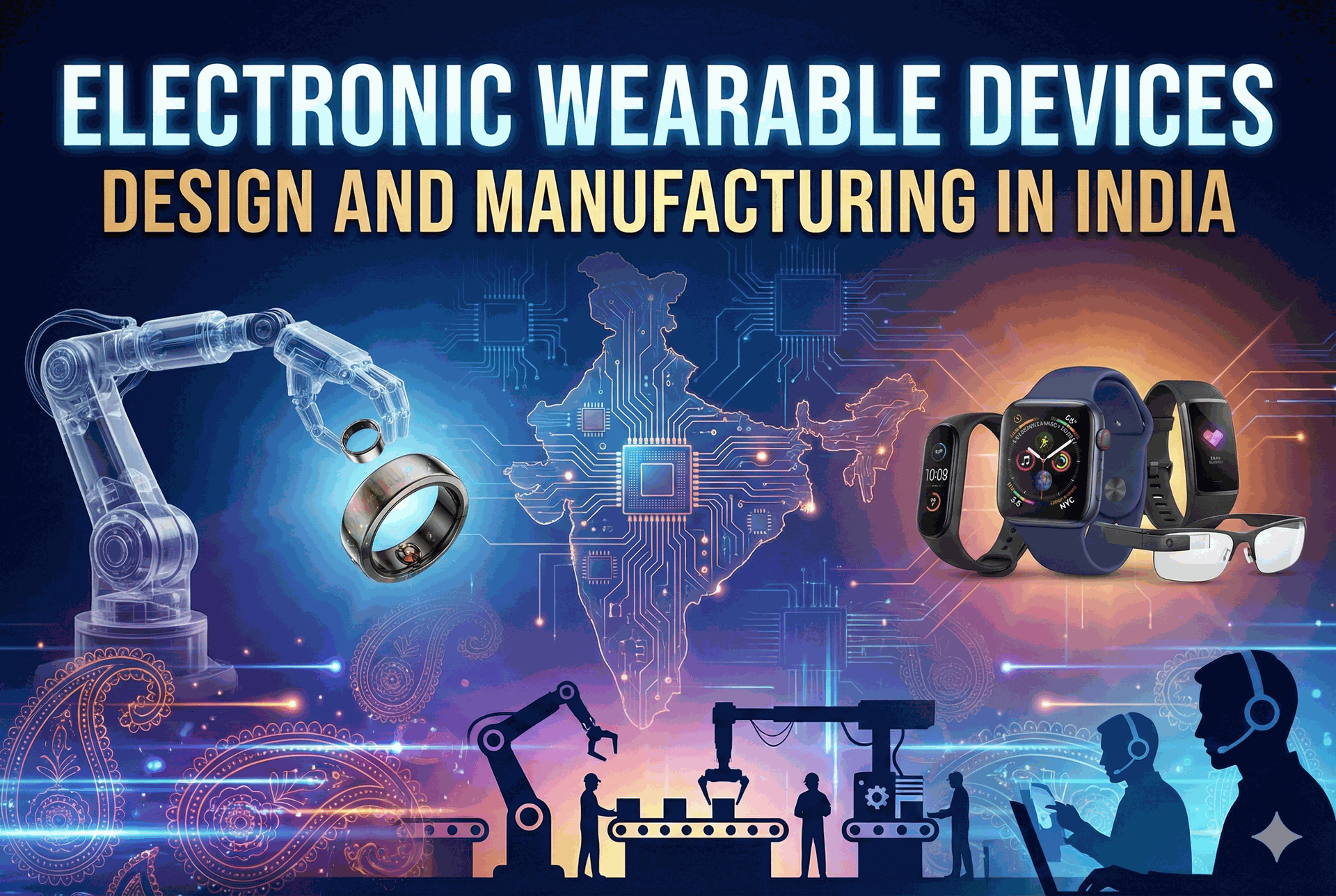
India’s electronics sector has moved well beyond basic assembly. Today, the country is actively manufacturing complex, compact, and regulation-sensitive electronic wearable devices at scale. While global conversations around wearables often emphasize industrial design or consumer features, the real competitive advantage lies in manufacturing execution. This is particularly true in India, where cost efficiency, engineering talent, and an evolving supplier ecosystem intersect.
This article focuses squarely on manufacturing wearable electronic devices in India, examining miniaturization challenges, ecosystem constraints, supply chain realities, and the role of electronics manufacturing services. It also includes emerging product categories such as smoking and vaping devices, which present unique manufacturing and compliance challenges.
Table of Content
Wearable Electronics Manufacturing in India
Wearable electronics encompass a broad category of compact electronic products designed for continuous or frequent human interaction. In the Indian manufacturing context, this includes:
- Wearable medical devices and wearable health devices
- Smart wearable devices such as fitness trackers and activity bands
- Compact consumer electronics worn on the body
- Handheld electronic smoking and vaping devices
What unifies these products is not their end use, but their manufacturing constraints. All require miniaturized electronics, tight assembly tolerances, reliable power management, and consistent quality across high volumes.
Wearable device manufacturers in India increasingly operate as integrated manufacturing partners, offering PCB assembly, device integration, testing, and box-build services under a single production framework.
Manufacturing-Centric Challenges in Miniaturized Wearable Devices
Miniaturization as a Manufacturing Problem
Miniaturization is often discussed as a design challenge, but in practice, it is a manufacturing challenge. Reducing device size directly impacts:
- PCB layout density
- Component sourcing and availability
- Assembly precision
- Yield rates during mass production
Compact wearable electronics frequently use fine-pitch components, micro-BGAs, and rigid-flex PCBs. These require advanced surface-mount technology processes and strict process control.
Even minor deviations in solder paste deposition, placement accuracy, or reflow profiling can lead to latent defects that only surface after deployment.
PCB Assembly Constraints in Wearable Manufacturing
PCB design services in India increasingly align their output with manufacturing realities. From a manufacturing perspective, wearable PCBs must account for:
- High component density in a limited board area
- Thermal stress in enclosed form factors
- Signal integrity for wireless communication
- Power efficiency for small batteries
Electronics manufacturing services in India supporting wearables invest heavily in inspection systems, including automated optical inspection and functional testing, to maintain acceptable yields at scale.
Battery Integration and Power Management at Scale
Battery integration is one of the most critical manufacturing challenges for wearable devices. Small form factors limit battery capacity, while end users expect long operational life.
From a manufacturing standpoint, challenges include:
- Safe handling and assembly of lithium-based cells
- Consistent electrical connections in compact enclosures
- Thermal safety during charging and discharging
- Mechanical reliability under repeated usage
These issues are amplified in wearable health devices and smoking or vaping devices, where power delivery consistency directly affects product performance and user safety.
Manufacturing Smoking and Vaping Devices in India
Electronic smoking and vaping devices represent a specialized segment of compact electronic device manufacturing. While not traditionally categorized alongside health wearables, they share similar manufacturing characteristics:
- Compact electronic assemblies
- Battery-driven power systems
- Heating elements or control circuits
- Enclosed mechanical housings
Manufacturing these devices requires precise control over component quality, electrical safety, and thermal behavior. Unlike many consumer wearables, smoking and vaping devices often face additional regulatory scrutiny and supply chain restrictions.
Indian manufacturers involved in this segment must navigate component sourcing limitations, evolving regulations, and strict quality assurance requirements while maintaining cost competitiveness.
Ecosystem Challenges in Wearable Device Manufacturing in India
Supply Chain and Component Availability
Despite growth, India’s electronics manufacturing ecosystem still relies on global component supply chains. Wearable devices often require:
- Miniaturized sensors
- Low-power wireless modules
- Specialized ICs and connectors
Supply chain disruptions can significantly affect production schedules. Wearable device manufacturers in India mitigate this through multi-sourcing strategies and close coordination with EMS partners.
Vendor Maturity and Process Consistency
Not all vendors in the ecosystem operate at the same maturity level. Consistency in soldering quality, material handling, and documentation varies across suppliers.
This makes vendor qualification and continuous process audits a critical part of wearable electronics manufacturing, especially for wearable medical devices that require traceability and repeatability.
Regulatory and Compliance Environment
Manufacturing wearable devices in India requires alignment with national and international standards. Compliance expectations vary depending on the device category and target market.
Organizations such as the Bureau of Indian Standards play a key role in defining applicable product and safety standards. For export-oriented manufacturing, additional international certifications may apply.
Regulatory clarity for newer product categories, including electronic smoking devices, remains an evolving area, adding complexity to manufacturing planning.
Skills and Infrastructure Constraints
While India has a strong base of electronics engineers, manufacturing wearable devices demands specialized skills in:
- Miniaturized PCB assembly
- Reliability testing
- Failure analysis
- Process optimization for compact electronics
Infrastructure gaps, particularly in high-precision assembly equipment and advanced testing facilities, can limit scalability for smaller manufacturers.
Role of Electronics Manufacturing Services in India
Electronics manufacturing services in India have become central to wearable device production. EMS providers offer scalable manufacturing capabilities that include:
- High-mix, low-volume prototyping
- Medium to high-volume production runs
- Integrated testing and quality assurance
- Supply chain and logistics coordination
For wearable device manufacturers in India, partnering with experienced EMS providers reduces capital expenditure and accelerates time to market while maintaining quality standards.
Manufacturing Readiness and Scale-Up Considerations
Transitioning from prototype to mass production is a critical phase. Many wearable devices fail not because of poor design, but due to inadequate manufacturing readiness.
Key scale-up considerations include:
- Process validation and pilot runs
- Yield optimization
- Automation feasibility
- Long-term component availability
Manufacturers that address these early issues achieve smoother production ramp-ups and lower total manufacturing costs.
India’s Position in Global Wearable Manufacturing
India’s electronics manufacturing push, supported by initiatives such as Make in India, has strengthened domestic capabilities in compact electronic device manufacturing.
Wearable device manufacturers in India increasingly serve global customers seeking alternatives to traditional manufacturing hubs. The ability to handle complex, miniaturized products positions India competitively in the wearable and compact electronics segment.
Conclusion
Electronic wearable devices manufacturing in India is defined by execution excellence rather than conceptual design alone. Miniaturization, supply chain coordination, regulatory compliance, and production consistency determine success in this sector.
From wearable medical devices and wearable health devices to smart wearable devices and electronic smoking or vaping products, Indian manufacturers are addressing complex manufacturing challenges with increasing sophistication.
As the ecosystem matures further, wearable device manufacturers in India are well positioned to support scalable, high-quality production for both domestic and international markets.
FAQs
-
What are electronic wearable devices?
Electronic wearable devices are compact electronic products designed to be worn on the body, such as fitness trackers, wearable medical devices, smart bands, and small handheld electronic devices with continuous user interaction.
-
What types of wearable devices are manufactured in India?
Wearable device manufacturers in India produce fitness wearables, wearable health devices, wearable medical devices, smart wearable devices, and compact electronic products including electronic smoking and vaping devices.
-
Why is India becoming a manufacturing hub for wearable devices?
India offers cost-efficient manufacturing, skilled electronics engineers, growing electronics manufacturing services, and policy support for domestic electronics production.
-
What are the main manufacturing challenges in wearable devices?
Key challenges include miniaturization, high-density PCB assembly, battery integration, yield control, and maintaining consistent quality at scale.
-
How does miniaturization affect wearable device manufacturing?
Miniaturization increases manufacturing complexity by requiring compact components, precise assembly processes, and tighter quality control.
-
What role do electronics manufacturing services in India play?
Electronics manufacturing services in India support PCB assembly, device integration, testing, and scalable production for wearable devices.
-
Why is PCB design critical for wearable device manufacturing?
PCB design impacts device size, power efficiency, wireless performance, and manufacturability, making it critical for reliable wearable electronics production.
-
Are wearable medical devices manufactured in India?
Yes. India manufactures wearable medical devices, provided manufacturers follow strict quality systems and applicable regulatory requirements.
-
Are electronic smoking and vaping devices manufactured in India?
Yes. Electronic smoking and vaping devices are manufactured in India as part of the compact electronic device manufacturing ecosystem, subject to regulatory constraints.
-
How should companies choose wearable device manufacturers in India?
Companies should assess manufacturing experience, quality controls, testing capabilities, supply chain reliability, and ability to scale production.