
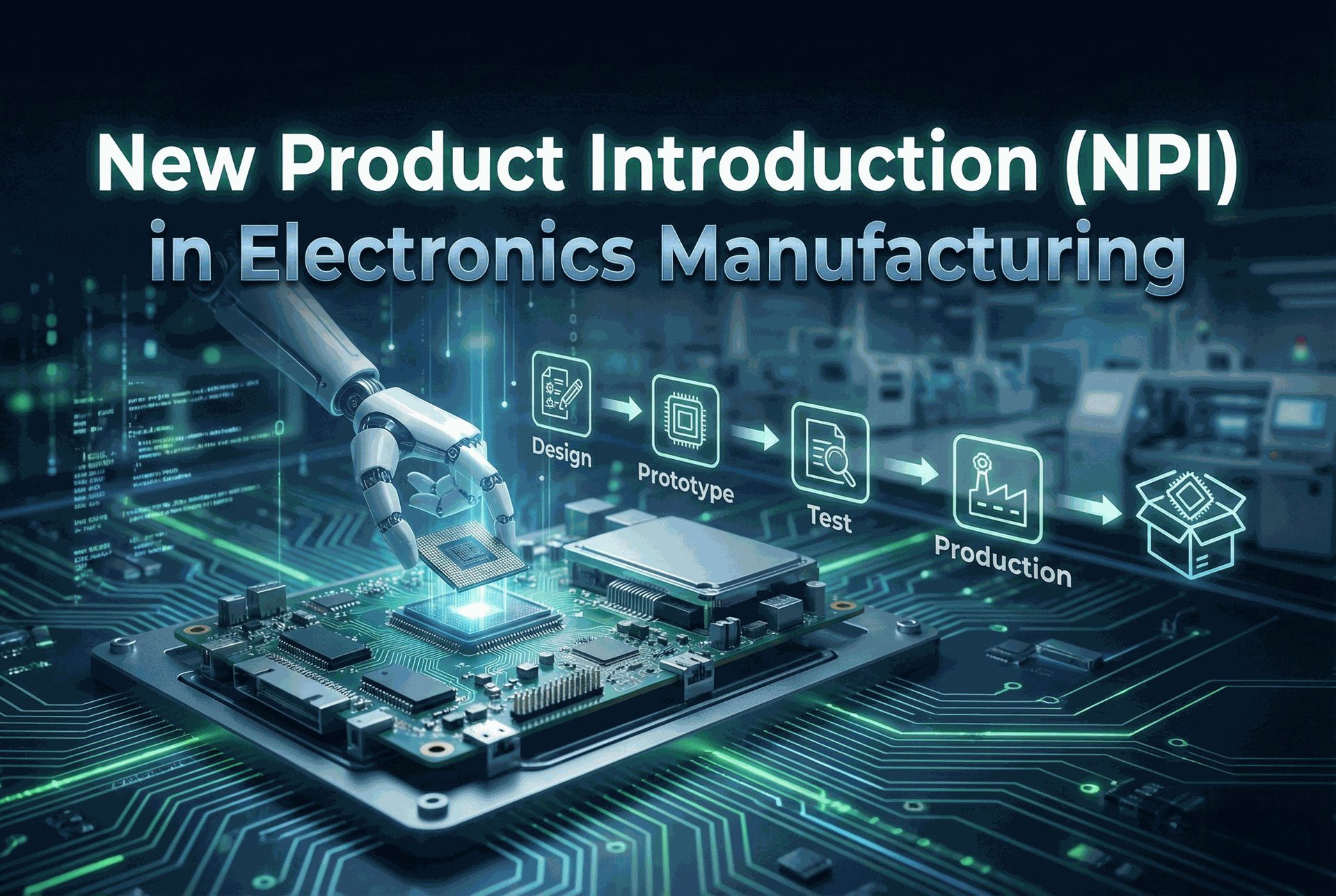
New Product Introduction is one of the most challenging and high-risk aspects associated with the manufacture of electronics. The NPI stage determines not only the capability to manufacture the product but also the ability to manufacture it multiple times in volume and without any supply chain issues. For engineering and procurement teams, the NPI stage marks the transition from the world of technical possibility to the world of manufacturing reality.
This article explains the new product introduction process in electronics manufacturing in practical, engineering-focused terms. It covers how NPI works, why it fails, and how to structure it correctly across PCB assembly, design for manufacturing, prototyping, pilot production, and supply chain planning.
Table of Contents
What Is New Product Introduction in Electronics Manufacturing?
The new product introduction process within the manufacturing space refers to the methodical process of moving a consumer electronic product from the conceptual to the production-ready state. The transition from the conceptual to the production-ready state within the electronic space is quite complex since it requires the following: PCB assembly, component procurement, compatibility evaluation, firmware validation, and coordination.
Unlike general product development, NPI manufacturing focuses on execution readiness. The objective is to prove that the product can be manufactured consistently, cost-effectively, and at the required quality level before full production begins.
A well-executed NPI process bridges the gap between concept and commercialization, reducing late-stage redesigns, supply chain surprises, and production delays.
Why NPI Matters in the Electronics Manufacturing Process
Electronics products fail in production more often due to poor NPI than poor design. Common issues include unavailable components, low assembly yields, excessive rework, and regulatory non-compliance. These problems are expensive to fix once production ramps up.
A disciplined new product introduction process enables:
- Early identification of manufacturability constraints
- Controlled prototype manufacturing and validation
- Predictable PCB assembly scale-up
- Stable BOM management and sourcing
- Lower risk during volume manufacturing
For organizations operating in regulated or high-reliability sectors, NPI also provides the framework for documentation, traceability, and compliance evidence.
Key Stages of the NPI Process in Electronics Manufacturing
While the exact structure varies by organization, a mature NPI process in electronics typically follows these stages.
1. Product Feasibility and Early Engineering Review
NPI begins with product feasibility analysis, not with fabrication. At this stage, engineering and manufacturing teams review schematics, PCB layouts, enclosure concepts, and performance requirements to identify risks.
Critical activities include manufacturability assessment, preliminary BOM review, and early supply chain checks. These steps determine whether the design aligns with real-world manufacturing constraints and component availability.
Early feasibility reviews prevent downstream redesigns that delay schedules and inflate costs.
2. Design for Manufacturing and Design for Assembly
Design for manufacturing and design for assembly are central to successful NPI in electronics. DFM in electronics ensures that PCB layouts, footprints, stackups, and tolerances are compatible with standard fabrication and assembly processes. DFA focuses on simplifying assembly steps to reduce error rates and cycle time.
Traditional DFM/DFA challenges are solder joint reliability, component spacing, panelization techniques, test access, and mechanical alignment. By addressing these early on in the process, higher yields and reduced time for transition from prototypes to pilot production can be achieved.
3. PCB Prototyping and Electronics Prototyping
Once the design is manufacturable, teams move into PCB prototyping and electronics prototyping. This phase validates both the electrical design and the physical build.
A reliable PCB assembly prototype service is critical here. Prototypes should be built using production-intent materials and processes wherever possible. This approach exposes assembly challenges, component substitutions, and tolerance issues early.
Prototype manufacturing during NPI is iterative. Multiple builds may be required to refine performance, assembly quality, and test coverage before proceeding further.
4. BOM Management and Supply Chain Readiness
Effective BOM management is often the deciding factor between a smooth NPI and a delayed launch. During this stage, procurement and engineering teams validate component availability, lead times, alternates, and lifecycle status.
Activities such as BOM optimization, supplier qualification, and obsolescence management reduce supply chain risk. Visibility into sourcing constraints allows teams to redesign or qualify alternatives before production pressure mounts.
Strong supply chain visibility during NPI prevents shortages, cost escalations, and line stoppages later in the product lifecycle.
5. Pilot Production and Process Validation
Pilot production is the first true test of the complete electronics manufacturing process. Limited-volume builds are run using production equipment, workflows, and quality controls.
During pilot runs, teams evaluate assembly yields, cycle times, defect trends, and test effectiveness. First article inspection and detailed process audits confirm that the product meets specifications and quality targets.
Issues identified during pilot production are far less costly to resolve than those found after full production launch.
6. Regulatory and Quality Validation
For many electronics products, regulatory compliance testing is a mandatory part of NPI. This includes safety, EMC, environmental, and industry-specific standards.
NPI also establishes quality documentation, traceability requirements, and inspection plans. Aligning NPI activities with recognized manufacturing standards, such as those published by IPC, strengthens long-term reliability and audit readiness.
How APQP, DFMEA, and PFMEA Improve NPI Success
Design for Manufacturing (DFM) and Design for Assembly (DFA) reduce obvious build issues, but they do not fully manage risk. In a mature NPI process, that role is handled by APQP, DFMEA, and PFMEA, which work together to prevent failures before production begins.
DFMEA (Design Failure Mode and Effects Analysis) is performed during the Product Design phase, before design freeze. It identifies risks introduced by the design itself, including PCB layout decisions, component selection, interfaces, materials, and tolerances. Addressing these risks early prevents costly redesigns once tooling, layouts, and compliance activities are locked.
PFMEA (Process Failure Mode and Effects Analysis) follows during the Process Design phase. It focuses on failures introduced by manufacturing and assembly, such as soldering variability, equipment setup, operator handling, and test execution. PFMEA ensures the product can be built consistently at scale, not just successfully in early builds. Its outputs directly drive process controls, inspection points, test strategy, and control plans.
Where DFMEA and PFMEA Fit in the NPI Workflow
In electronics and other high-reliability industries, NPI is commonly structured using the APQP (Advanced Product Quality Planning) framework, where DFMEA and PFMEA are mandatory deliverables.
| NPI Phase | Activity | Key Deliverable |
| Phase 2 | Product Design | DFMEA |
| Phase 3 | Process Design | PFMEA |
| Phase 4 | Validation | Control Plan (derived from PFMEA) |
| Phase 5 | Launch | Production |
The control plan used during pilot and volume manufacturing is derived directly from PFMEA findings, ensuring known risks are actively monitored and controlled.
How APQP Structures the NPI Timeline
APQP defines how NPI is executed in a controlled and repeatable way by breaking it into clear phases with required quality outputs.
| APQP Phase | NPI Focus | Key Deliverables |
| Phase 1 | Plan and Define | Voice of Customer, Project Goals, Risk Assessment |
| Phase 2 | Product Design | DFMEA, Design Verification, Prototype Builds |
| Phase 3 | Process Design | PFMEA, Production Flow, Factory Layout |
| Phase 4 | Validation | Trial Runs, PPAP (Production Part Approval Process) |
| Phase 5 | Launch and Feedback | Mass Production, Continuous Improvement |
In practice, NPI defines what needs to happen, APQP structures the process, and DFMEA and PFMEA manage risk within it. Skipping any of these shifts NPI from proactive risk prevention to reactive problem-solving after launch, increasing cost and instability.
Cross-Functional Collaboration in NPI Manufacturing
Successful new product introduction in electronics depends on cross-functional collaboration. Engineering, manufacturing, supply chain, quality, and program management must operate as a single system.
Breakdowns in communication often lead to conflicting assumptions, late changes, and missed requirements. Structured design reviews, shared data systems, and clearly defined ownership reduce friction and keep NPI on schedule.
From a product lifecycle management perspective, NPI establishes the foundation for consistent production and future revisions.
Real-World Application of NPI in Electronics Manufacturing
In practice, successful new product introduction depends less on theory and more on execution discipline. Electronics manufacturers that routinely manage complex NPI programs tend to follow structured validation gates, maintain tight alignment between engineering and sourcing, and involve manufacturing partners early.
For example, organizations such as MicroLOGIX apply NPI frameworks that integrate design for manufacturing reviews, controlled PCB prototyping, and pilot production validation before scaling. This approach helps identify assembly risks, component constraints, and quality issues while changes are still manageable.
The takeaway is not the specific organization, but the method. NPI works best when treated as a system, not a checklist.
Common NPI Risks and How to Mitigate Them
Even experienced teams encounter challenges during NPI manufacturing. Common risks include:
- Incomplete DFM validation leading to low yields
- Inadequate supplier qualification
- Poor prototype-to-production alignment
- Late BOM changes driven by component shortages
Applying risk mitigation strategies such as early supplier involvement, phased validation builds, and disciplined change control significantly improves outcomes.
NPI as a Long-Term Manufacturing Strategy
The new product introduction process is not discrete because it lays down the foundation for the performance to be expected from the product during its lifecycle. All decisions regarding NPI impact cost management, quality, scalability, and serviceability.
Organizations treating NPI as a capability, rather than an outcome to be achieved in projects, will drive accelerated launches, optimal yields, and optimal total cost of ownership.
Final Thoughts
The process of NPI helps in transforming the electronics manufacturing process from a reaction to a prediction. Adding DFM to the electronics process helps in managing the whole process and reduces the time-to-market. Thus, it helps in transforming the whole process from a reaction to a prediction.
For engineers, product managers, and supply chain professionals, mastering the NPI process is not optional. It is the foundation of reliable, scalable electronics manufacturing in an increasingly complex global environment.
FAQs
-
How long does a typical NPI cycle take in electronics manufacturing?
The NPI timeline varies by product complexity. Simple PCB-based products may complete NPI in 6 to 10 weeks, while complex, multi-board or regulated systems can take 3 to 6 months or longer. Factors such as component availability, compliance testing, and design maturity have a significant impact.
-
At what point should manufacturing partners be involved in NPI?
Manufacturing partners should be involved before the design freeze. Early engagement enables manufacturability feedback, cost modeling, sourcing validation, and realistic production planning. Late involvement often results in avoidable redesigns and schedule delays.
-
How many prototype iterations are typically required during NPI?
Most electronics programs require two to four prototype iterations. Early builds focus on functionality and assembly validation, while later builds refine yields, testing, and process repeatability. Skipping iterations increases downstream production risk.
-
What documentation is critical during the NPI process?
Key NPI documentation includes manufacturing drawings, assembly instructions, test procedures, inspection criteria, change logs, and revision-controlled BOMs. Complete documentation ensures repeatability and supports quality audits.
-
How does NPI affect long-term manufacturing costs?
Decisions made during NPI directly influence tooling expenses, scrap rates, labor efficiency, and supplier pricing. Investing time in DFM and supply chain validation during NPI typically reduces total lifecycle cost far more than post-launch cost-cutting.
-
Can NPI be executed in parallel with product development?
Yes, but only with clear controls. Parallel execution is common in fast-moving markets, but it requires disciplined change management, frequent design reviews, and risk containment strategies to prevent uncontrolled production changes.
-
How does NPI support product scalability?
NPI validates whether a product can move from low-volume builds to higher production without quality degradation. This includes assessing line balancing, test coverage, material flow, and supplier capacity before demand increases.
-
What role does the testing strategy play in NPI?
The testing strategy defined during NPI determines defect detection efficiency in production. Poor test planning leads to escaped defects and warranty issues, while well-designed test coverage improves yield and reduces field failures.
-
How should engineering change requests be handled during NPI?
Engineering changes during NPI should follow a formal review and approval process. Each change must be evaluated for impact on cost, schedule, tooling, compliance, and supplier readiness to avoid uncontrolled disruption.
-
When is a product considered “NPI complete”?
NPI is considered complete when the product demonstrates stable yields, approved quality metrics, validated suppliers, locked documentation, and predictable production performance across multiple builds.