
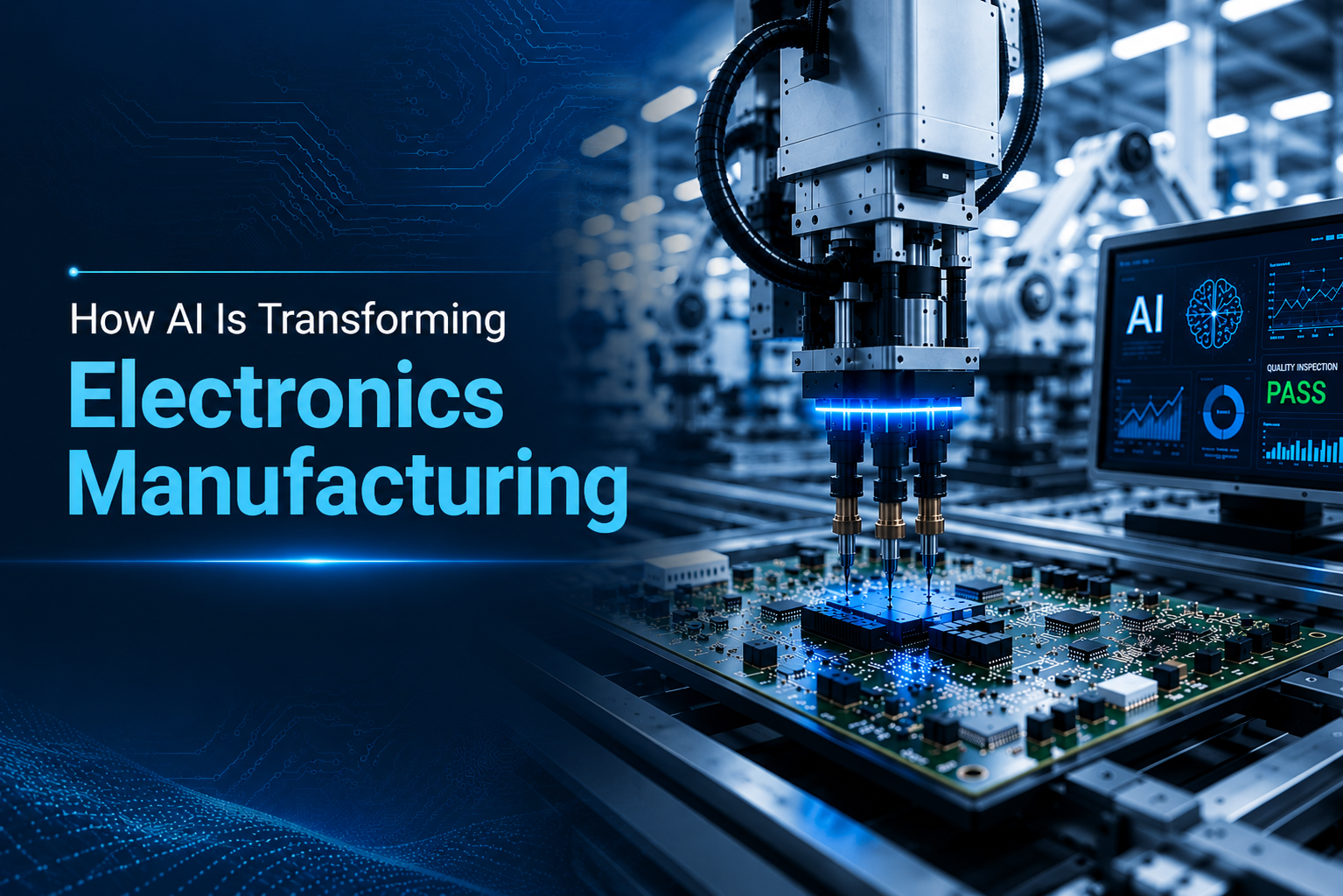
Artificial intelligence is moving from software applications into the machines that build and test electronic products. Today, AI is influencing solder paste inspection, component placement, reflow, optical inspection, X-ray, electrical testing, and functional testing.
For an EMS provider such as MicroLOGIX, this shift is more than factory automation. It is about using intelligent equipment to improve production speed, inspection accuracy, process consistency, and traceability while reducing unnecessary manual intervention.
Table of Content
What Is AI in Electronics Manufacturing?
AI in Electronics Manufacturing combines artificial intelligence, machine learning, computer vision, data analytics, and connected equipment across the electronics manufacturing process.
Traditional automation follows predefined instructions. AI-driven production can analyse images, machine conditions, and historical production data to identify patterns, detect anomalies, and support faster decisions.
AI Is Transforming the Electronics Manufacturing Process
AI is now influencing almost every major stage of the SMT and PCBA workflow. The biggest impact can be seen in seven areas.
1.SPI: Faster and Smarter Solder Paste Inspection
Solder Paste Inspection (SPI) measures solder paste height, area, volume, and position before components are placed. It provides the first major quality check after printing.
The supplied MAKER-RAY AIS 63X-HW SPI equipment demonstrates how this category is evolving. Its brochure highlights AI-assisted programming, Gerber-file import, automatic element search, quick programming, SPC data analysis, and an inspection speed of approximately 0.28 seconds per FOV.
For MicroLOGIX, the practical value is clear: faster product setup, earlier defect detection, and less routine programming work for operators.
2.Pick-and-Place: Reducing Programming and Setup Time
Pick-and-place machines determine how quickly and accurately components are mounted onto a PCB. Newer Chinese machines are increasingly combining high-speed placement with machine vision, automatic optimisation, and simplified programming.
AI-assisted systems can help optimise feeder allocation, placement paths, nozzle selection, and component recognition. This reduces repetitive programming work and can shorten changeover time, particularly when an EMS facility handles multiple PCB designs.
The benefit is not the elimination of skilled engineers. Instead, their time can move away from repetitive setup and toward process optimisation, troubleshooting, and production improvement.
3.Reflow: AI Is Improving Process Control
Reflow determines how solder paste melts and forms reliable electrical and mechanical connections. Temperature consistency is therefore critical to PCB assembly quality.
AI can work with thermal sensors, historical profiles, and process data to identify deviations and support profile optimisation. Combined with digital twin technology, manufacturers can also model thermal behaviour before making changes to the physical process.
For an EMS operation such as MicroLOGIX, intelligent reflow control can help reduce process-development effort while improving recipe management, repeatability, and real-time monitoring.
4.AOI: AI Is Changing Visual Inspection
AOI is one of the areas where the impact of AI is particularly visible. Traditional AOI depends heavily on programmed inspection rules and operator review of false calls.
Products like the MAKER-RAY AIS 501-HW Series take a more intelligent approach. It includes AI training, continuous model self-training for special components, AI based positioning for mixed PCB and multi-in-1 inspection, fuzzy-feature inspection, SPC analysis, and online/offline programming. It also has a stated inspection speed of approximately 0.26 seconds per FOV.
For MicroLOGIX, that means AOI can become more than a final inspection gate. It can generate useful SPC data for improving the wider manufacturing process.
5.X-ray: Improving Inspection of Hidden Defects
AOI cannot inspect hidden solder joints inside packages such as BGAs and QFNs. X-ray inspection is therefore essential for detecting issues such as voids, hidden solder defects, and internal connection problems.
AI can analyse 2D and 3D X-ray images to identify and classify defects more quickly. This reduces the amount of manual image interpretation required from experienced operators.
For complex electronics assembly, AI-assisted X-ray can therefore support faster visual inspection, more consistent defect classification, and stronger production traceability.
6.ICT: Turning Electrical Test Data Into Process Insights
In-Circuit Testing (ICT) checks electrical characteristics and assembly conditions, including opens, shorts, component values, and other faults.
AI can analyse large volumes of ICT results to identify recurring failure patterns. Instead of treating every failed board separately, manufacturers can identify relationships between failures, components, PCB revisions, and production conditions.
For products such as industrial electronics and power supply units, this type of analysis can help MicroLOGIX identify recurring problems earlier and support more effective root-cause investigation.
7.Functional Testing: Moving Beyond Simple Pass or Fail
Functional testing verifies whether an assembled product performs its intended function. Depending on the product, this may include communication, firmware, sensors, power outputs, or other operating conditions.
AI can analyse functional-test data to identify recurring failures and borderline results. Combined with robotics and automated test handling, it can also reduce repetitive manual intervention.
Connecting the Entire PCB Assembly Process
The real advantage of AI appears when individual machines are connected.
SPI provides solder-paste data. Pick-and-place machines provide placement information. Reflow provides thermal-process data, while AOI and X-ray identify assembly defects. ICT and functional testing add electrical and performance results.
When these systems connect through AI manufacturing systems, MES, and industrial IoT, manufacturers can analyse the complete production history.
How Equipment Economics Are Changing
The important development is not simply lower equipment pricing. Chinese SMT and inspection manufacturers are increasingly combining competitive equipment costs with intelligent software and automation.
Capabilities:
- AI-assisted programming
- Automatic parameter optimisation
- Machine vision
- Automated defect classification
- MES connectivity
- Real-time data collection
- Automated traceability
This changes the economics of factory automation. Advanced inspection and intelligent equipment can become practical even for manufacturers that previously considered such systems too expensive.
What This Means for Skilled Technicians
AI does not make experienced manufacturing engineers unnecessary. It changes where their expertise is used.
Instead of spending significant time on repetitive inspection programming, false-call review, or routine data analysis, technicians can focus on:
- Process optimisation
- Root-cause analysis
- Equipment validation
- Quality decisions
- New-product introduction
- Production troubleshooting
This distinction is important. The goal of AI factory automation is not to remove engineering knowledge. It is to reduce repetitive work so skilled people can concentrate on higher-value decisions.
Benefits of AI in Manufacturing
The benefits of AI in manufacturing become measurable when AI is applied to specific production problems
| Manufacturing challenge | AI-enabled improvement |
| Long inspection programming | AI-assisted programming |
| High false-call volume | Intelligent defect classification |
| Slow changeovers | Automated setup and optimisation |
| Repetitive inspection review | Machine vision and AI analysis |
| Recurring test failures | Data-driven pattern analysis |
| Limited production visibility | SPC and real-time monitoring |
| Unplanned equipment problems | Predictive maintenance |
Why AI Matters for India’s Electronics Manufacturing Growth
India is expanding its electronics and semiconductor manufacturing ecosystem through initiatives such as the PLI programme and Modified Electronics Manufacturing Clusters.
As factories scale, maintaining production speed and quality while controlling skilled labour requirements becomes increasingly important.
For Indian EMS providers such as MicroLOGIX, AI-enabled equipment offers a practical route toward greater automation, stronger traceability, and more consistent production without treating automation as a replacement for engineering expertise.
What Should Manufacturers Consider Before Implementing AI?
Manufacturers planning equipment investments should start with the production bottleneck.
- Programming time and ease of setup
- Inspection or placement throughput
- False-call performance
- AI model-training capability
- Mixed-PCB support
- CAD/Gerber integration
- SPC and production-data capabilities
- MES/SMEMA connectivity
- Traceability
- Service and technical support
- Total cost of ownership
How MicroLOGIX Fits Into This Shift
For an EMS partner, adopting AI is not simply about adding new machines. The equipment must work within a reliable manufacturing process that includes DFM, PCB assembly, inspection, testing, traceability, and process engineering.
MicroLOGIX can bring these elements together to help OEMs evaluate where intelligent automation can deliver measurable value. The objective is simple: use the right technology at the right stage of production rather than automate for the sake of automation.
Conclusion
AI is now embedded across SPI, pick-and-place, AOI, X-ray, and ICT, not layered on afterward. The goal is not to automate everything. It is to find the real bottleneck, whether programming time, false calls, or rework, and fix that first.
For Indian OEMs, this only pays off inside a process built to use the data. MicroLOGIX brings DFM, assembly, inspection, and traceability together. Explore MicroLOGIX’s EMS and manufacturing services.
FAQs
1.What is AI in electronics manufacturing?
AI in electronics manufacturing uses machine learning and computer vision to analyse production data across SMT and PCBA stages, detecting defects and patterns faster than fixed rule-based automation.
2. How does AI improve Automated Optical Inspection (AOI)?
AI-powered AOI analyses image datasets to classify defects more accurately, reducing false calls that would otherwise need manual review by technicians during inspection.
3. Can AI reduce PCB assembly changeover time?
AI-assisted programming in pick-and-place and SPI systems can shorten setup and changeover time by automating feeder allocation, nozzle optimisation, and placement-path calculation.
4. Does AI replace In-Circuit Testing (ICT)?
No. AI analyses ICT results to reveal failure patterns across boards and revisions. It supports the electrical test process; it does not replace it.
5. How does AI help with X-ray inspection of BGAs?
X-ray systems use AI to analyse 2D and 3D images, identifying hidden solder defects in BGAs and QFNs faster than manual interpretation alone.
6. Is AI-enabled equipment only useful for high-volume production?
No. AI-assisted inspection and programming reduce setup time and rework even in mixed-volume or low-volume production, not only high-volume runs.
7. Where should a manufacturer start with AI adoption?
Manufacturers should identify their biggest bottleneck first, such as inspection programming or false calls, then apply AI there before expanding it further.
8. How does AI support India’s electronics manufacturing growth?
AI-enabled equipment helps manufacturers scale output under PLI and EMC initiatives without a proportional rise in skilled labour requirements.
9. Does AI-assisted equipment eliminate the need for skilled technicians?
No. AI reduces routine manual work in programming and classification, but experienced engineers remain essential for process improvement and reliability decisions.
10. How does MicroLOGIX evaluate AI in its manufacturing process?
MicroLOGIX evaluates AI-enabled equipment against actual production bottlenecks, integrating it within DFM, assembly, inspection, and traceability rather than automating without purpose.