
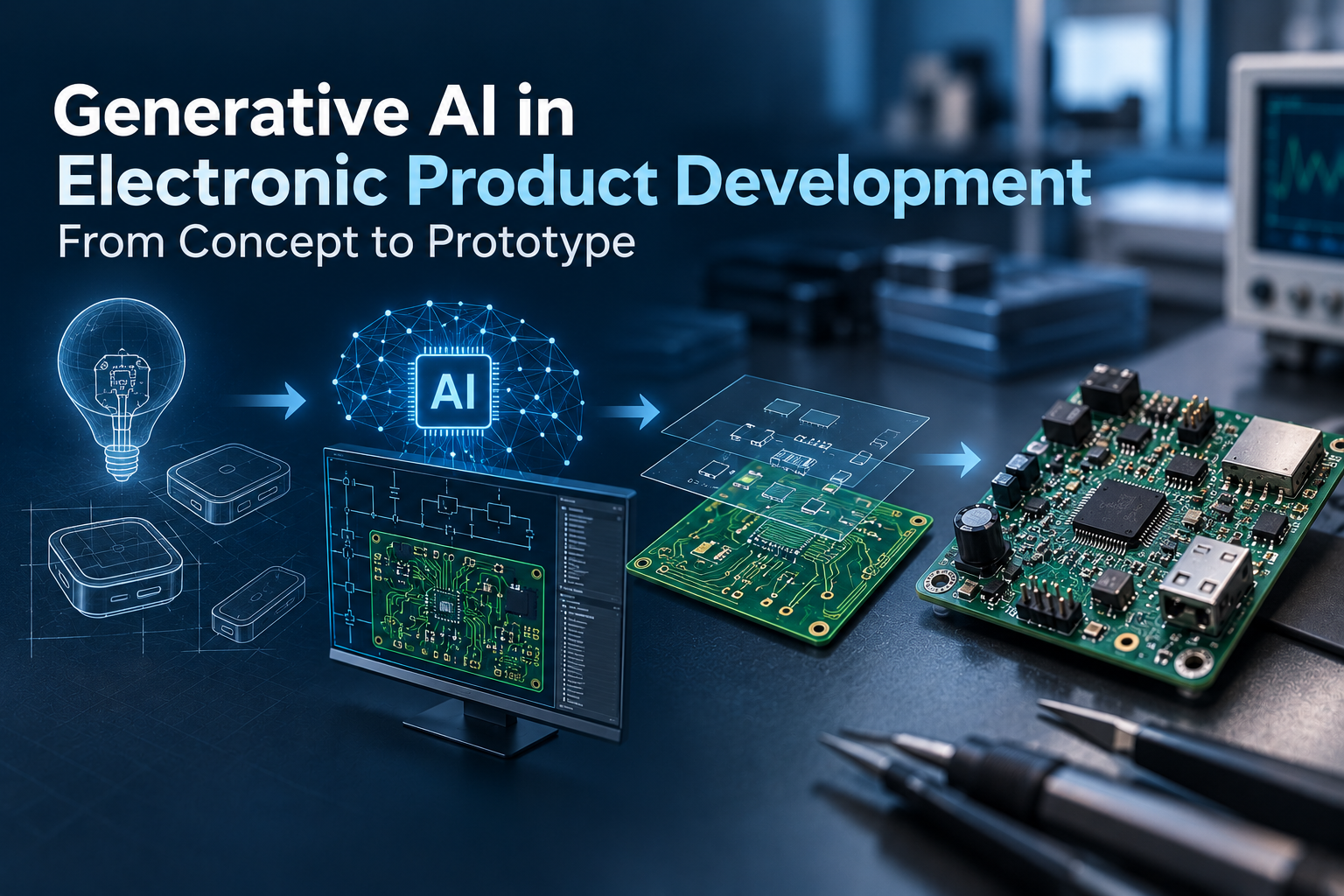
Product development timelines used to stretch across months before a single prototype reached the benchmark. Generative AI in electronic product development is changing that pace. It does not replace engineering judgement. It removes the repetitive groundwork that slows engineers down, so design decisions happen faster and with fewer blind spots.
This shift matters the most in the early stages: concept, schematic, layout, and first prototype. That is where generative AI in electronic product development earns its place, not as a shortcut, but as a working tool inside the design process.
Table of Contents
What Generative AI Actually Does in Electronics Design
Generative AI in electronics design analyses design inputs (component libraries, constraints, prior layouts) and produces suggestions an engineer can accept, adjust, or reject. It does not design a product independently.
In practice, this looks like
- Suggesting component alternatives based on availability, cost, and thermal behavior
- Flagging layout conflicts before they reach manufacturing
- Generating multiple schematic variations against the same constraint set
- Predicting where a design is likely to fail design rule checks
Ask how generative AI is used in electronics design, and the straightforward answer is: it compresses the iteration loop. Engineers used to run these checks manually, one variation at a time. AI-powered electronics design tools run them in parallel and surface the results engineers actually need to review.
From Concept to Schematic: AI-Assisted Electronics Design
Every electronic product starts as a set of requirements: power budget, form factor, environmental rating, cost ceiling. AI-assisted electronics design tools take those requirements and generate schematic options that satisfy them.
This does not mean the engineer steps back. It means the engineer starts review at option five instead of option one. The team spends its time evaluating trade-offs, not building the first draft from a blank canvas.
For OEMs working in tight development windows, this is the practical value of AI-driven product development: fewer dead-end schematic revisions and more time spent validating the direction that actually works.
Generative AI for PCB Design and Prototyping
PCB layout is where generative AI shows its clearest, highly measurable impact. Generative AI for PCB design and prototyping tools handles constraint-heavy tasks that used to consume days of manual routing.
Typical capabilities include:
- Layout optimisation: Routing traces to meet impedance, spacing, and thermal requirements automatically
- Design for Manufacturing (DFM) flagging: Identifying issues before they reach fabrication, not after
- Signal integrity checks: Modelling how high-speed signals behave across a proposed layout
- Thermal simulation: Predicting hotspots before the board is built
AI-assisted PCB design does not remove the need for a qualified layout engineer. It removes the need for that engineer to manually check every trace against every rule, every time a change is made.
Rapid Prototyping with AI
Turnaround is where prototyping teams feel this most directly. A design change used to mean a fresh manual review of the entire layout. With AI electronics prototyping tools, that review happens automatically, and the team gets a flagged list of what actually needs attention.
This changes prototyping in three concrete ways:
- Fewer prototype revisions caused by errors that should have been caught earlier
- Faster turnaround between design freeze and first build
- More prototype iterations possible within the same development budget
The result is not just speed. It is more room to test ideas before committing to tooling and production runs.
Where MicroLOGIX Fits In
MicroLOGIX designs and builds electronics for OEMs from its Bangalore facility, covering PCB design, assembly, and end-to-end electronic manufacturing services. Generative AI in electronic product development sits inside that existing capability. It does not replace it.
Our design engineers use AI-assisted tools during schematic and layout stages to catch conflicts early and to test more design variations within the same project timeline. The output still goes through the same engineering review, DFM checks, and quality process every MicroLOGIX project follows.
For OEMs bringing a new product to a Bangalore-based manufacturing partner, this means:
- Design reviews that surface problems before fabrication, not after
- Prototype cycles built around checked, validated layouts
- A design and manufacturing team working from the same data, without handoff gaps
The Role of AI in Electronics Product Design: What It Cannot Do
Real limits exist here, and naming them matters more than overselling the technology.
AI tools cannot:
- Make a final call on a safety-critical design trade-off
- Understand the business context behind a client’s requirements
- Replace hands-on testing under real environmental and load conditions
- Guarantee manufacturability without human DFM review
This approach works because engineers treat its output as a starting point for review, not a finished answer. That discipline is what keeps a design reliable, not the tool itself.
Bringing AI-Assisted Design Into Your Next Product Development Cycle
Generative AI in electronic product development is a working part of how modern OEM projects move from concept to prototype faster, with fewer errors reaching the fabrication stage. The tools help. The engineering judgement around them is what makes a design manufacturable and reliable.
If your team is planning a new product and wants a design and manufacturing partner that applies these tools with the review process to back them, talk to MicroLOGIX about your next development cycle.
For a wider view of where this fits across the factory floor, see How AI Is Transforming Electronics Manufacturing.
Conclusion
Generative AI in electronic product development shortens the path from concept to prototype. It flags errors early, tests more design options, and gives engineers more time to focus on decisions that need human judgment.
MicroLOGIX applies these tools within our PCB design and manufacturing process, backed by full engineering review at every stage. If you are planning a new product, talk to our team about your next development cycle.
Frequently Asked Questions
1. What is generative AI in electronic product development?
Generative AI in electronic product development uses design data to suggest schematics, layouts, and component choices. Engineers review and refine every suggestion before use.
2. How is generative AI used in electronics design?
Generative AI in electronics design analyses constraints like power, cost, and thermal limits, then generates design options. It speeds up early-stage decisions, not final approval.
3. What is AI-assisted PCB design?
AI-assisted PCB design uses software to optimise trace routing, flag manufacturing issues, and check signal integrity before fabrication, reducing manual review time significantly.
4. Can generative AI speed up electronics prototyping?
Yes. Generative AI for rapid electronics prototyping catches layout errors before the build stage, reducing prototype revisions and shortening the time between design freeze and first build.
5. What is the role of AI in electronics product design?
AI supports design decisions with suggestions and checks. It cannot replace engineering judgment on safety, manufacturability, or real-world testing outcomes.
6. Does MicroLOGIX use AI in electronic product development?
Yes. MicroLOGIX applies AI-assisted tools during schematic and layout stages, with all output reviewed through our standard engineering and quality process.