
Your Vision, Our Technology
Washing Machine Controller
An OEM adding a new wash profile should not need a new washing machine controller. That is the problem the Wash Master solves. MicroLOGIX built this ARM processor-based controller for industrial and commercial washer extractors, and it holds up to 30 wash programs on one platform, each named and stored independently, so a single hardware design covers multiple machine variants instead of one board per configuration.
The control board runs wash programming, detergent dosing, heating, and safety interlocks from a single unit, and connects to a PC when networked monitoring is required. Inverter connectivity handles variable speed washing and extraction through one analog output, so wash speed and extraction speed both run off the same control logic.
What This Washing Machine Controller Delivers
An OEM evaluating a washing machine control board is usually solving one problem: the existing controller either cannot hold enough wash programs, lacks safety interlocks that meet current requirements, or fails too often in the field to be worth the unit cost. The Wash Master addresses this with an embedded controller architecture built around a 32-bit ARM processor, a door lock safety switch as standard, and vibration sensing logic that protects the machine when loads shift or run unbalanced.
The control board supports up to 30 customised wash cycles, so a single hardware platform can serve multiple machine configurations. Water levels are programmable within each cycle through a pressure-based water level sensing input, and temperature control runs through a dedicated temperature sensor feeding dual heaters that can be configured for steam or electrical heating depending on the installation. Detergent dosing covers five separate compartments (A through E), which is enough to handle pre-wash, main wash, and multiple additive stages without manual intervention.
Nothing in this needs to be taken on faith. Every specification below comes directly from the Wash Master technical datasheet, and it is presented in enough detail for a design engineer to check fit before committing to procurement.
Why OEMs Choose This Washing Machine Control Module
Buyers comparing control boards rarely decide on price alone. What matters more: how many wash configurations one board can hold, how it survives vibration and unbalanced loads in the field, and whether someone picks up the phone after the sale.
Thirty customised wash cycles cover most laundry segments (hospitality, healthcare linen, industrial garment washing) from one control platform. That range matters because five-compartment detergent dosing lets a facility stage pre-wash, main wash, and additive treatments without anyone standing at the machine to add detergent by hand.
Two things protect that investment once it is installed:
- Vibration sensing logic is built into the control logic itself, not bolted on as a separate module, so the bill of materials stays shorter and there is one less part to fail.
- Error and status messages appear directly on the LCD screen in plain language, which cuts the time a technician spends guessing what went wrong on-site.
Key Features of the Wash Master Control Board
This is where most procurement teams start their comparison, and it is deliberately the most literal section on this page.
Processing and control
- 32-bit ARM processor architecture, functioning as the system's embedded microcontroller
- More than 50 customisable parameters governing the wash process
- Alphanumeric keypad for naming individual wash programs
Wash programming
- Up to 30 customised wash cycles
- Programmable water levels within each cycle
- Temperature-controlled wash function
Detergent and heating
- Five-compartment detergent control (A, B, C, D, E)
- Dual heaters, configurable for steam or electrical heating
Safety
- Door lock safety switch
- Vibration sensing logic to protect the machine during unbalanced loads
Interface and connectivity
- Large LCD display with well-laid keypad
- Optional USB or RS485 port for PC connectivity
- Inverter connectivity for regular wash mode and extraction mode
Inputs, Outputs, and Electrical Specification
Design engineers integrating a washing machine control circuit into a new build need the input and output map before anything else on this page matters. It is reproduced here exactly as specified.
| Category | Detail |
|---|---|
| Power supply | 10 to 18 VAC from transformer |
| Analog inputs (2) | Temperature sensor input, washing machine pressure sensor input for water level |
| Digital inputs | Vibration switch, door open sensing, swing, speed, bottom level |
| Analog outputs | 0 to 10V for inverter controller; water level sensing inputs |
| Relay outputs (16) | 2 door relay (Door 1 + Door 2), 5 detergent outputs (A to E), 2 heater outputs (steam + coil), 2 drain outputs (internal + external), 2 water outputs (hot + cold), extraction output, program finish, hooter alarm |
Sixteen relay outputs is a meaningful number for this class of controller. It means detergent staging, dual drain paths, and hot and cold water control can all run independently, without an external relay bank added to the design.
Mechanical and Build Specification
A control board that meets every electrical requirement is still unusable if it does not survive the environment it is installed in. Washing machine controllers sit close to water, steam, and vibration, so build quality is not a secondary consideration
| Specification | Detail |
|---|---|
| Dimensions | 263mm (W) x 183mm (H) x 46mm (D) |
| Weight | 2000 grams |
| Construction | IP65 grade water-proof ABS enclosure |
| Cable entry | 3 PG9 glands, for solar panel, battery, and actuator connections |
| Operating temperature | -5°C to 55°C |
| Relative humidity | 85% RH, with no condensation |
User Interface and Front Panel
Operators interacting with the machine day to day are usually not the engineers who specified it, so the front panel needs to communicate status clearly without requiring training on the underlying control logic.
- LCD display, 40x2 character format
- Full alphanumeric keypad for entering and naming wash programs
- Four navigation keys (left, right, up, down) for menu control
- Process status LED indications for: start, pause, stop, water filling, taking detergent, temperature control, washing process, draining process, cover lock, extraction process, and fault alarm
- Dedicated functional keys: menu, start, enter, pause, ESC/reset, stop
Wiring and System Integration
Integration risk is one of the more common reasons a promising controller gets rejected late in the design cycle. The Wash Master’s I/O layout is documented at the terminal level, not abstracted behind a proprietary interface.
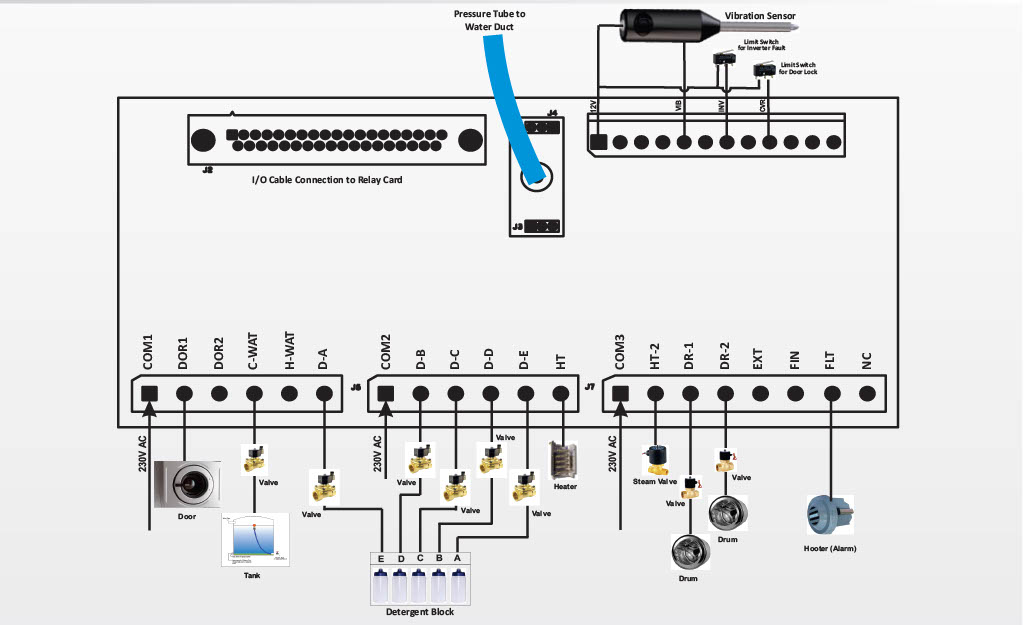
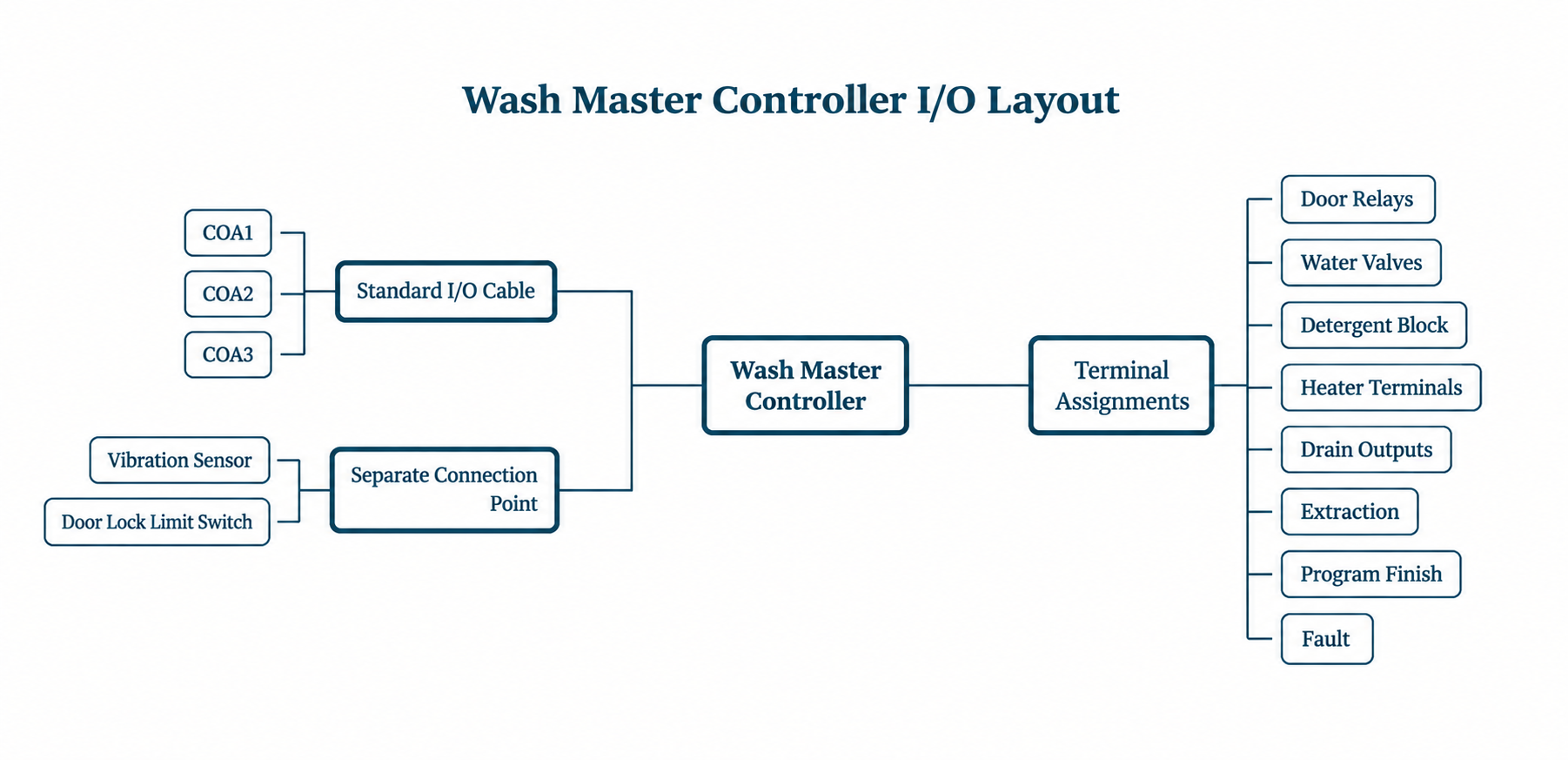
The controller connects to a relay card via a standard I/O cable, with three common terminals (COM1, COM2, COM3) distributing power across the output groups. Terminal assignments include door relays (DOR1, DOR2), hot and cold water valves (H-WAT, C-WAT), the five-position detergent block (D-A through D-E), dual heater terminals (HT, HT-2), drain outputs (DR-1, DR-2), extraction (EXT), program finish (FIN), and fault (FLT). A separate connection point handles the vibration sensor and door lock limit switch, both of which feed directly into the safety logic described above.
Why Manufacture With MicroLOGIX
Specifying the right washing machine controller is only half the decision. The other half is who builds it, and whether that manufacturer can support the product through its full lifecycle, not just at the point of sale.
MicroLOGIX operates as an OEM washing machine controller manufacturer from its Peenya Industrial Area facility in Bangalore, with in-house capability spanning hardware design, power electronics and control systems, and automated PCB assembly through to box-build integration. As a washing machine PCB board supplier, MicroLOGIX sits alongside control panel manufacturers that handle the full cycle from board design to finished unit, rather than outsourcing washing machine PCB assembly to a third party. The Wash Master’s more than 50 customisable parameters reflect this directly: the same control platform can be configured to different wash logic requirements for different OEM customers, without a full hardware redesign each time.
Frequently Asked Questions
A washing machine controller is the electronic control board that manages a washing machine's wash cycles, water levels, temperature, detergent dosing, and safety interlocks. In industrial and commercial washer extractors, it typically also manages heating and extraction speed through connected inverters.
Yes. The Wash Master supports up to 30 customised wash cycles and more than 50 adjustable parameters, which allows OEMs to configure wash logic for specific fabric types, load sizes, or facility requirements without changing the underlying hardware.
Yes. The controller connects to an inverter for both regular wash mode and extraction mode, enabling variable speed operation rather than a single fixed speed setting.
The controller includes a door lock safety switch and vibration sensing logic, both wired directly into the control system rather than added as external modules.
The enclosure is IP65 rated and water-proof, with an operating temperature range of -5°C to 55°C and tolerance for up to 85% relative humidity without condensation.
MicroLOGIX designs and manufactures washing machine control boards as an EMS provider, with in-house PCB assembly and box-build capability.
Tell Us About Your Product Needs
Ready to Specify This Washing Machine Controller for Your Build
Engineering teams that need the full I/O map, wiring diagram, or a configuration discussion for a specific wash application can reach MicroLOGIX directly. Requests are handled by the same team that designs and manufactures the controller, not a general sales desk.