
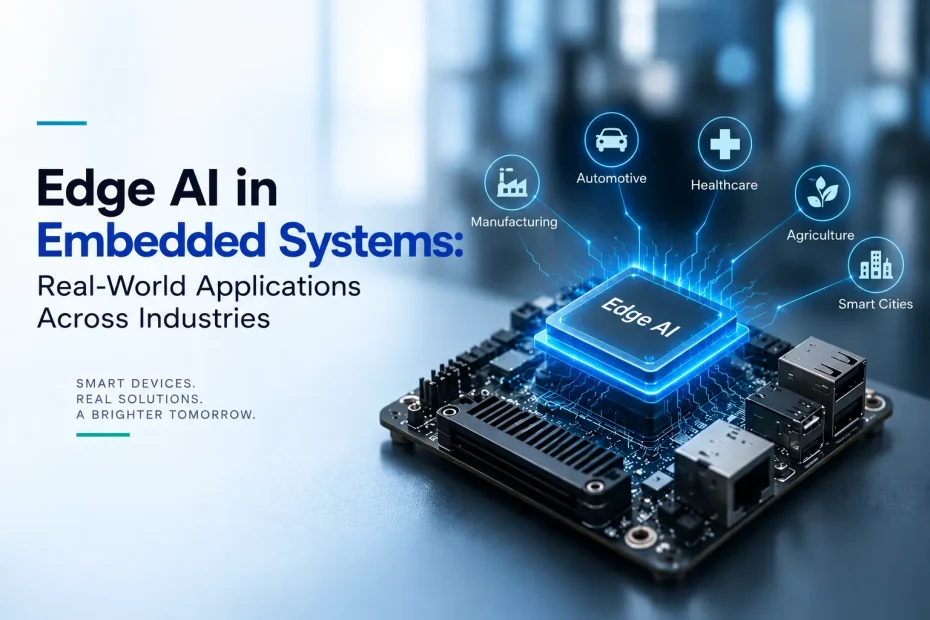
Cloud AI has a delay problem. A sensor detects an anomaly, sends the data out, waits for a server somewhere to think about it, then waits again for the answer to come back. In a hospital monitor or a factory line, that round trip can cost more than time. Edge AI in embedded systems removes the wait. The intelligence sits inside the device itself, so decisions happen where the data is generated, not miles away in a data centre.
This shift is not theoretical. Edge AI in embedded systems is already running inside medical devices, factory sensors, building controllers, and logistics trackers, doing the thinking locally instead of leaning on a constant internet connection.
Table of Content
What Edge AI in Embedded Systems Actually Solves
Three problems push engineering teams toward the edge: latency, bandwidth, and dependence on connectivity that is not always there.
Cloud-based AI works well when a small delay is acceptable. It fails when a machine needs to shut down before a fault propagates or when a wearable needs to flag an irregular heart rhythm the moment it occurs. Edge computing in embedded systems processes data on the device, cutting the response time from seconds to milliseconds.
Bandwidth is the second constraint. A single industrial camera generating continuous video does not need to send every frame to the cloud for classification. It only needs to send the moments that matter. Embedded AI systems filter and decide locally, then transmit a summary or an alert, not the raw stream. That reduces network load and data costs substantially.
Connectivity is the third. Remote logistics hubs, in-field industrial equipment, and mobile infrastructure sites do not always have reliable internet access. A device relying entirely on the cloud for its intelligence stops working the moment the connection drops. One built with Edge AI keeps functioning regardless of network availability.
How Edge AI Applications Work Inside Embedded Devices
An embedded AI system runs a trained machine learning model directly on the device’s processor, rather than sending data to an external server for inference. The model is usually trained in the cloud on a larger dataset, then compressed and optimised to run on hardware with far less memory and power than a data centre GPU.
Generative AI electronic product development helps at the training stage too. Synthetic sensor data can fill gaps for rare faults that are hard to capture in the field. The model then learns from a wider range of conditions before compression.
This compression step is where embedded machine learning becomes an engineering discipline in its own right. A model that performs well on a workstation will not necessarily run on a right microcontroller with limited RAM. Techniques such as quantisation and pruning bring the model down to a size the hardware can actually handle, without erasing the accuracy that made it useful in the first place.
Edge AI Applications Across Industries
The theory is consistent. The application changes with the environment the device has to survive in, and what happens if it gets the decision wrong.
- Healthcare: Patient monitors use Edge AI to flag abnormal vitals instantly, without sending sensitive readings to an external server. MicroLOGIX’s IoT for healthcare solutions build on-device intelligence that responds immediately and keeps patient data local.
- Industrial infrastructure: Vibration and temperature sensors with embedded AI catch early signs of bearing wear or motor imbalance on the factory floor; no cloud link required. This is the core of MicroLOGIX’s IoT for industrial infrastructure
- Building Management Systems (BMS): Embedded AI adjusts HVAC, lighting, and occupancy systems by reading sensor data on-site, cutting reliance on constant cloud connectivity. This sits inside MicroLOGIX’s IoT for building management system
- Logistics automation: Tracking devices across warehouses and transit routes detect cargo anomalies and automate sorting locally, syncing centrally only when connected. MicroLOGIX addresses this through IoT for logistics automation.
- Mobile infrastructure: Remote telecom units and mobile monitoring stations need intelligence that keeps working when the network does not. MicroLOGIX’s IoT solutions for mobile infrastructure are built for that reality.
- Retail and smart shelving: Embedded AI at the point of sale reads stock levels and shelf activity in real time, flagging gaps or shrinkage without a constant cloud feed. Response stays instant even on unreliable store network connections.
- Agriculture: Field sensors process soil moisture, temperature, and crop-health data on-site, triggering irrigation or alerts without waiting on connectivity that rural deployments rarely guarantee consistently.
- Automotive and smart mobility: In-vehicle systems use embedded AI for driver assistance and diagnostics, processing sensor data on-board where a delayed response is not an acceptable trade-off for connectivity savings.
The Role of Embedded Systems in Enabling Edge AI
None of this works without hardware built for the job. An Edge AI model does not run on assumptions; it runs on a specific processor, with a specific power budget, inside an enclosure that has to survive a specific environment. That is where embedded system design earns its place in the conversation.
Thermal management is one example most software teams underestimate. An AI-capable chip generates heat during inference, and a compact industrial enclosure does not always have room for active cooling.
Getting the thermal design wrong means throttled performance or premature hardware failure, regardless of how well the model itself was trained. Power budgeting is another. A battery-powered field sensor cannot afford to run inference constantly; the hardware and the model need to be designed together, not handed off separately.
This is the layer where design-for-manufacturing (DFM) discipline, component selection, and compliance requirements (from EMI shielding to certification standards relevant to the target industry) determine whether an Edge AI concept becomes a product that actually ships or stays a prototype that worked once on a lab bench. MicroLOGIX’s role sits precisely here: translating a validated AI model into design embedded hardware that holds up under real operating conditions, at a production scale.
Where Edge AI Technology Is Headed
Processor manufacturers continue releasing chips built specifically for on-device inference, with dedicated AI accelerators drawing a fraction of the power older general-purpose processors needed for the same task. That trend lowers the barrier for smaller, battery-powered devices to run models that previously needed a wired power source.
The practical effect for OEMs: Edge AI in IoT is becoming less of a specialised, high-cost decision and more of a standard design consideration, the way wireless connectivity became standard a decade ago. Teams evaluating a new embedded product now have to ask not just whether it needs a sensor, but whether it needs to think for itself.
Conclusion
Edge AI in embedded systems is not a future capability. It is running today in healthcare monitors, industrial sensors, building controllers, logistics trackers, and mobile infrastructure equipment, wherever a decision cannot afford to wait on a network connection. Building it correctly takes more than a trained model; it takes embedded hardware designed around that model’s real constraints. If your product needs local intelligence built into the hardware from day one, talk to MicroLOGIX’s engineering team about your design requirements.
Frequently Asked Questions
1. What is Edge AI in embedded systems?
Edge AI in embedded systems means running AI models directly on a device’s processor, so it can analyse data and make decisions on-site, without sending data to the cloud first.
2. How is Edge AI different from cloud-based AI?
Cloud AI sends data to a remote server for processing. Edge AI processes data locally on the device, reducing latency and working even without a constant internet connection.
3. Which industries use Edge AI in IoT devices?
Healthcare, industrial automation, building management, logistics, and mobile infrastructure all use Edge AI for real-time monitoring, predictive maintenance, and local decision-making.
4. Why does embedded machine learning need model compression?
Embedded hardware has limited memory and processing power. Compression techniques like quantisation and pruning shrink AI models so they run efficiently on that hardware.
5. Does Edge AI improve data privacy?
Yes. Since data is processed on the device rather than transmitted to external servers, Edge AI reduces the amount of sensitive data leaving the device, supporting privacy requirements.
6. What role does embedded system design play in Edge AI?
Hardware design determines whether an Edge AI model actually works in the field: managing power, heat, component selection, and compliance for the device’s real operating environment.