
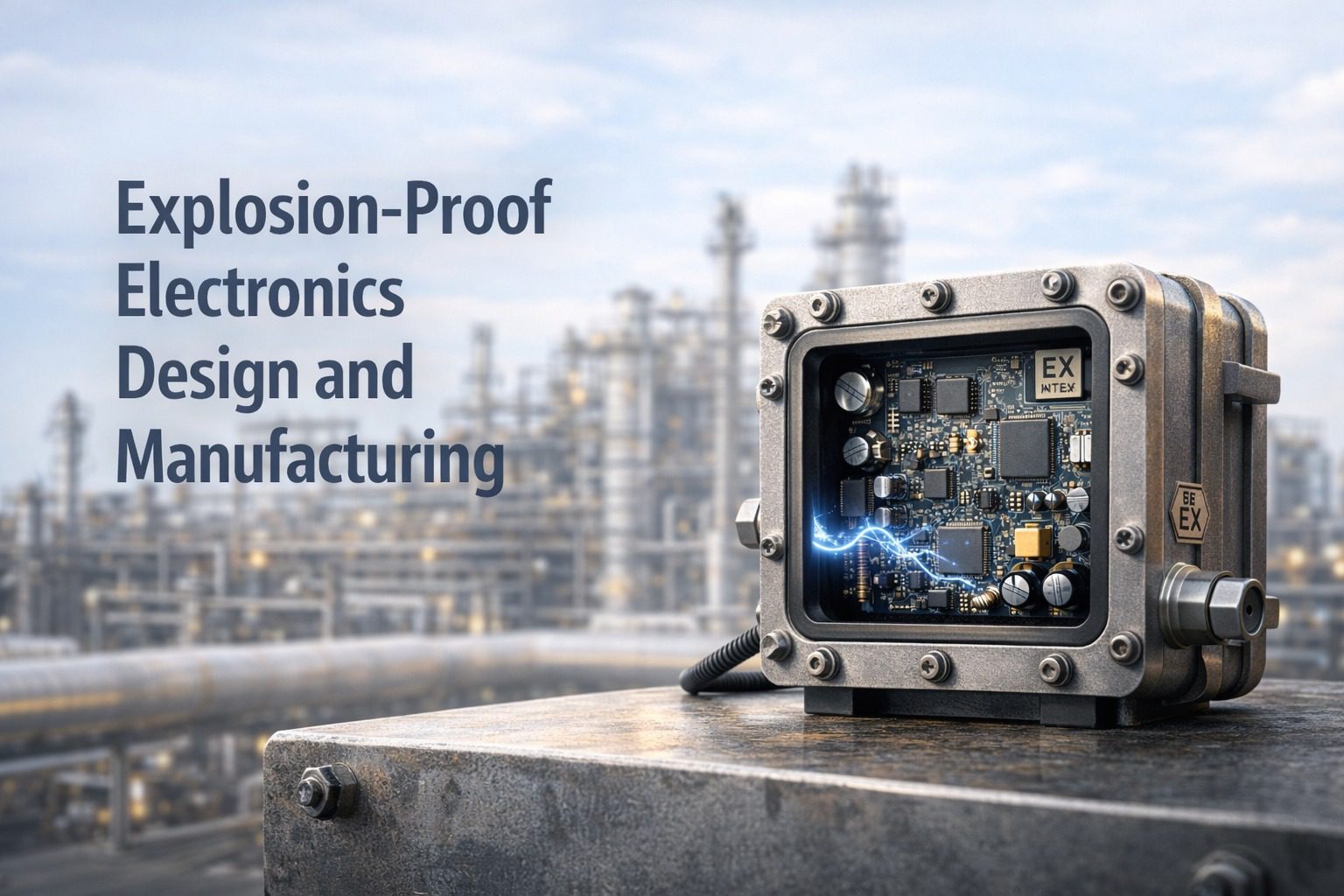
Explosive atmospheres leave no room for error. A minor arc, an overheated trace, or a poorly controlled solder joint can escalate into operational shutdown, equipment damage, or regulatory penalties.
Oil and gas facilities, petrochemical plants, mining operations, and heavy process industries require electronics engineered with one objective above all else: ignition prevention without compromising performance.
MicroLOGIX delivers Electronics Design and Manufacturing Services purpose-built for hazardous area applications. We design and manufacture explosion-proof and fire-resistant electronic systems that align with international standards and real-world industrial reliability.
Table of Contents
Explosion-Proof PCB Assembly for Zone 0, Zone 1, and Zone 2 Applications
Explosion-proof does not mean “survives an explosion.” It means that any internal ignition event is contained and cannot ignite the surrounding atmosphere.
Design strategy depends on hazardous area classification. Each zone defines how likely explosive gases or vapors are present and directly influences enclosure engineering, component selection, circuit energy/power limits, and thermal control.
| Zone | Atmosphere Presence | Engineering Approach |
| Zone 0 | Continuous presence | Intrinsically safe, energy-limited circuits |
| Zone 1 | Likely during operation | Flameproof enclosure or protected architecture |
| Zone 2 | Unlikely but possible | Reinforced protection with monitoring controls |
Our explosion-proof PCB assembly preserves containment strategy throughout production. Trace routing, isolation spacing, and grounding integrity are validated before boards move to final assembly. High-energy components are encapsulated where necessary, and surface temperature limits are reviewed against applicable T-class requirements.
This is not standard PCB manufacturing with a hazardous label applied at the end. Protection strategy is engineered from the first schematic review.
Talk to Our Explosion-Proof PCB Engineers
Intrinsically Safe Electronics Design Support
Intrinsic safety is the most reliable method for preventing ignition in high-risk zones.
Instead of containing an explosion, intrinsically safe systems prevent it entirely by limiting electrical and thermal energy below ignition thresholds. Even in fault conditions, the system cannot generate a spark capable of ignition.
MicroLOGIX supports:
- Energy-limited power design
- Intrinsic safety barrier integration
- Fault analysis modeling
- Temperature rise simulation
- Component derating strategies
We align designs with IEC 60079 equipment standards and support documentation required for ATEX and IECEx certification pathways.
Explosion-proof Electronics Enclosure Design
Designing explosion-proof electronics enclosures (often referred to as Ex d protection) involves strict adherence to international standards like IEC 60079-1 (Global) or UL 1203/NFPA 70 (North America).
Contrary to popular belief, “explosion-proof” does not mean the enclosure won’t explode; it means the enclosure is strong enough to contain an internal explosion and prevent it from igniting the hazardous atmosphere surrounding it.
Common enclosure materials include:
Cast Aluminum: Lightweight but must have low copper content ($<0.1\%$) to prevent corrosion and sparks.
Stainless Steel (316L): Ideal for offshore or corrosive environments.
Cast Iron: Used for heavy industrial motor starters and switchgear.
Most Ex d enclosures are rated IP66 or IP67. This usually involves a dedicated O-ring that sits outside the flamepath area so it doesn’t interfere with the metal-to-metal flame-extinguishing gap.
Fire-Resistant PCB Manufacturing and Thermal Control
Fire resistance is not achieved by selecting a flame-retardant substrate alone. It requires controlling heat at both the PCB, component and system levels.
Our fire-resistant PCB manufacturing process starts with UL-Flame Retardant PCB Laminate selection and integrates thermal dissipation strategy directly into board layout. Copper balancing, thermal vias, and controlled soldering profiles reduce localized hotspots. Also, we use all UL approved high voltage components and connectors to minimise arcing besides maintaining clearances for high voltage tracks. Where required, conformal coatings and encapsulation are applied to protect insulation performance in humid or dust-heavy environments.
Surface temperature classification from T1 through T6 is evaluated during engineering validation. Gas groups IIA, IIB, and IIC demand careful thermal modeling because ignition thresholds vary significantly.
Without proper dissipation pathways, even compliant materials can become hazardous. We design to prevent that outcome.
Book a Compliance Consultation
Paper Electronics Integration for Distributed Hazardous Monitoring
Paper-based flexible electronics allow lightweight sensor deployment across complex industrial assets. In hazardous environments, this approach is used primarily for low-energy distributed sensing applications.
However, substrate flexibility does not define compliance. The system architecture does.
Paper electronics must be encapsulated and integrated within certified explosion-proof enclosures. Energy limitation, enclosure containment, and system-level validation determine suitability for classified environments. When engineered correctly, flexible sensing layers expand monitoring coverage without introducing ignition risk.
MicroLOGIX ensures that compliance decisions are based on full-system validation, not isolated material properties.
Compliance with ATEX, IECEx, and IEC Standards
Hazardous electronics require third-party validation. Assumed compliance is an operational risk.
We support alignment with:
- ATEX Directive for European explosive atmospheres
- IECEx international certification scheme
- IEC 60079 series for explosive atmosphere equipment
- IEC 60695 fire hazard testing procedures
Our engineering team performs ignition source risk analysis, temperature classification validation, and enclosure-level containment evaluation before production release.
Safety-Critical Electronics Manufacturing Discipline
Engineering intent must survive manufacturing reality.
MicroLOGIX integrates design validation with controlled production workflows to protect explosion-proof integrity.
Our process includes:
- Automated Optical Inspection (AOI) on every board
- X-ray inspection for BGA and critical components
- Thermal profile verification during soldering
- Controlled contamination handling
- IPC-aligned inspection standards
- Full traceability from BOM to shipment
Even minor solder deviations can compromise hazardous system safety. We eliminate that risk through disciplined process control.
Secure Architecture for Connected Hazardous Systems
Industrial hazardous electronics increasingly connect to monitoring platforms for predictive maintenance and real-time diagnostics. While physical ignition control remains primary, digital integrity now supports operational safety.
Secure firmware management, authenticated communication protocols, and segmented network architecture prevent unauthorized modification of safety-critical parameters. Protection must function at both physical and digital levels.
Industrial Applications and High-Growth Segments
Explosion-proof and fire-resistant electronics are increasingly integral to industrial sectors where process continuity, regulatory compliance, and operational safety are non-negotiable.
MicroLOGIX supports hazardous-area electronics manufacturing across critical applications, including:
- Industrial pump control systems operating within flammable fluid environments
- Lubrication monitoring and control modules are deployed in refineries and heavy rotating machinery
- Explosion-proof automation panels for chemical and petrochemical processing facilities
- Gas detection and environmental monitoring systems in oil, gas, and mining operations
- Industrial IoT-enabled control units installed within classified zones
Pump systems, lubrication control technologies, and explosion-proof electronic designs represent expanding segments driven by regulatory tightening, asset reliability initiatives, and large-scale industrial automation programs.
The scope of automation in hazardous environments continues to broaden. Facilities are transitioning from manually monitored systems to integrated, sensor-driven control architectures. As automation density increases, so does the demand for intrinsically safe, thermally controlled, and compliance-validated electronic systems.
MicroLOGIX aligns engineering and manufacturing practices with this evolution, ensuring that automation advancement is supported by ignition-controlled and regulation-ready electronics infrastructure.
Why MicroLOGIX for Hazardous Area EMS?
We are not a general PCB supplier adapting to hazardous applications. MicroLOGIX differentiates itself in three areas that directly impact project risk and certification timelines:
- Specialized hazardous-area expertise – Explosion-proof PCB assembly and intrinsically safe system support engineered specifically for Zone-classified environments, not adapted from general-purpose designs.
- Compliance integrated into production – ATEX and IEC-aligned documentation, temperature class validation, and ignition-risk assessment considered during design and preserved through manufacturing.
- Process control that protects reliability – Strict inspection protocols, validated solder profiles, controlled coating and encapsulation, and end-to-end traceability to prevent latent field failures.
We do not approach hazardous electronics as a variation of standard EMS work. We structure engineering and production around ignition prevention, thermal stability, and regulatory alignment from day one.
The outcome is reduced compliance risk, controlled thermal exposure, and faster progression toward certification approval.
Frequently Asked Questions
What is explosion-proof PCB assembly?
It is PCB manufacturing engineered so that any internal ignition event is contained within certified enclosures and cannot ignite external explosive atmospheres.
What is the difference between intrinsically safe and flameproof design?
Intrinsically safe design limits electrical energy below ignition thresholds. Flameproof design contains an internal explosion within a robust enclosure.
Can flexible or paper electronics be used in hazardous areas?
Yes, but only when energy levels are limited and the system is integrated within certified protective enclosures. Certification depends on overall system architecture.
What temperature classes apply to hazardous electronics?
Equipment is classified from T1 to T6 based on maximum surface temperature limits. Design must ensure compliance under worst-case operating conditions.
Do you support ATEX and IECEx certification processes?
We support engineering documentation, ignition risk assessment, and design validation required for third-party certification pathways.
What testing is required for hazardous area electronics?
Ignition risk analysis, surface temperature validation, dielectric strength testing, and enclosure containment testing are typically required before certification.
Why is IPC Class 3 preferred for explosion-proof PCBs?
IPC Class 3 ensures higher solder integrity and stricter inspection standards, reducing failure risk in safety-critical environments.
Is conformal coating necessary in hazardous zones?
Yes. It protects against dust, moisture, and chemical exposure that could degrade insulation and increase ignition risk.
Can certified explosion-proof electronics be modified later?
Any modification usually requires re-evaluation. Changes can void certification if not properly reviewed.
How does vibration impact hazardous electronics?
Vibration can weaken solder joints and increase electrical resistance, potentially leading to localized heating. Robust assembly controls minimize this risk.
Build Compliant Electronics for High-Risk Environments
Hazardous applications demand engineered containment, disciplined manufacturing, and verified compliance alignment.
MicroLOGIX combines explosion-proof PCB assembly expertise with safety-critical electronics manufacturing discipline to deliver reliable, regulation-ready systems for industrial environments where failure is not an option.