
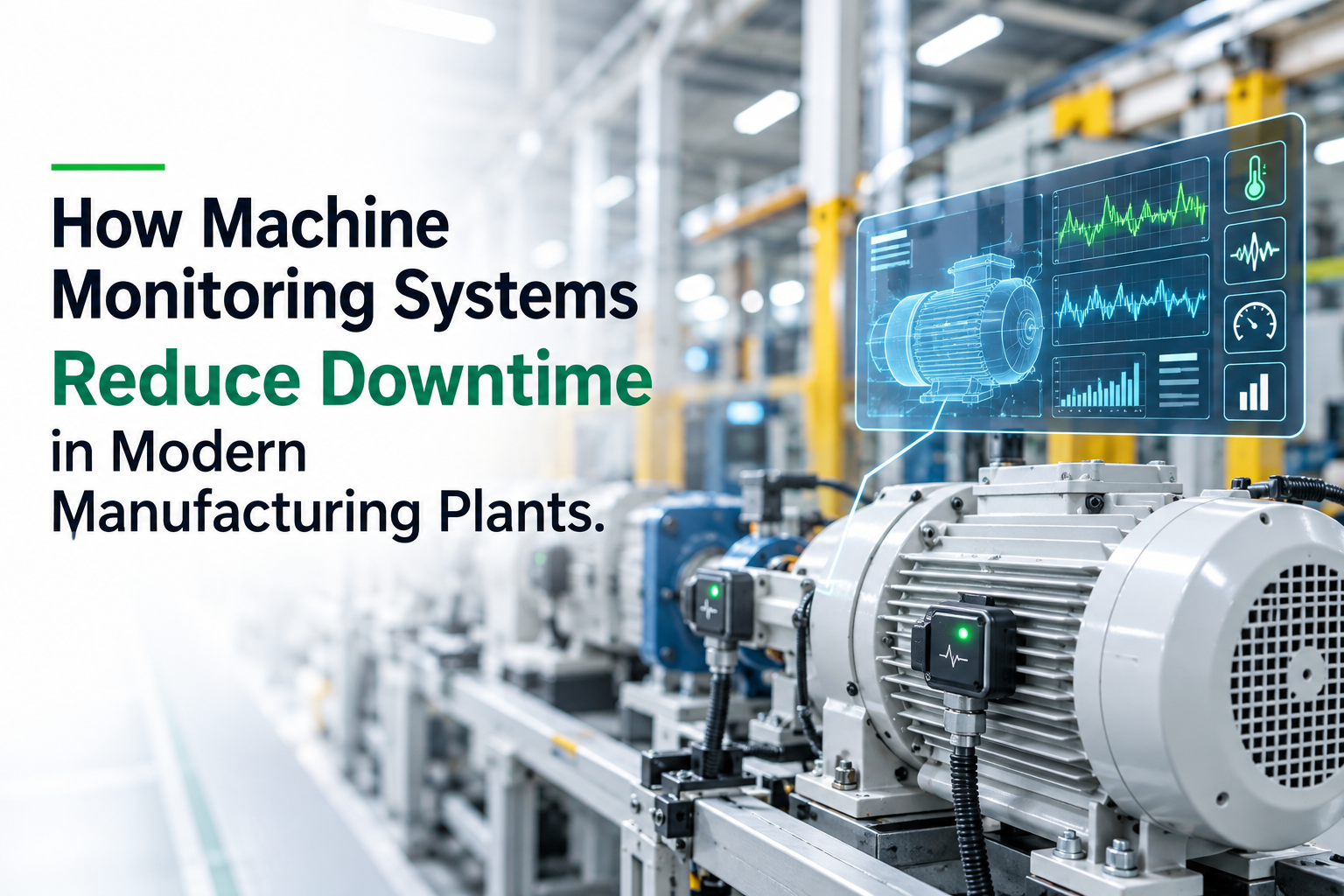
A machine monitoring system is a hardware and software solution that continuously tracks equipment health, production metrics, and environmental conditions in real time. It detects early warning signs of failure, enabling manufacturers to reduce downtime in manufacturing environments through predictive and condition-based maintenance strategies.
Unplanned downtime causes industrial manufacturers to lose thousands of dollars per hour. Industry benchmarks from Siemens and Deloitte show that severe disruptions in high-volume facilities can escalate into losses of hundreds of thousands depending on asset criticality. Even brief interruptions trigger supply chain delays, missed shipments, and long-term customer trust erosion.
Understanding the Machine Monitoring System
A machine monitoring system is an integrated hardware and software framework designed to continuously capture, analyse, and interpret machine-level data. It connects sensors, controllers, communication gateways, and analytics platforms to deliver real-time operational insights.
At its core, industrial machine monitoring focuses on:
- Equipment health parameters such as vibration, temperature, pressure, and current draw
- Production metrics, including cycle time, throughput, and reject rates
- Environmental conditions affecting equipment performance
- Alarm states and fault codes from PLCs and CNC controllers
In advanced deployments, a large industrial machine is able to monitor environmental conditions such as ambient temperature, humidity, dust concentration, and voltage fluctuations. These variables often influence failure rates and product quality. Integrating environmental data into the monitoring architecture strengthens diagnostic accuracy.
The Downtime Challenge in Modern Manufacturing
Downtime in manufacturing typically falls into two categories:
- Planned Downtime – Scheduled maintenance, changeovers, inspections
- Unplanned Downtime – Mechanical failure, electrical faults, operator error, process instability
Unplanned downtime is the primary concern. Common root causes include:
- Bearing and gearbox failures
- Motor overheating
- Hydraulic leakage
- Tool wear and misalignment
- Power quality issues
Traditional maintenance models rely on reactive repairs or time-based servicing. These methods often result in either unexpected breakdowns or unnecessary maintenance. Both scenarios reduce production line efficiency.
A machine monitoring system replaces guesswork with data-driven decision-making.
5 Ways a Machine Monitoring System Reduces Downtime
- Detects vibration anomalies before bearing failure
- Identifies overheating motors before thermal shutdown
- Flags hydraulic pressure drops before system collapse
- Monitors power instability that damages drives
- Triggers automated work orders through CMMS integration
Real-Time Machine Monitoring: Immediate Visibility
Real-time machine monitoring provides continuous data acquisition from connected assets. Using edge devices and industrial protocols such as Modbus, OPC UA, and Ethernet/IP, plant operators receive instant updates on machine status.
Key features include:
- Live dashboards displaying asset performance
- Automated alerts for threshold breaches
- Historical trend analysis
- Event logging for downtime tracking software
This real-time visibility enables operations teams to identify anomalies before they escalate. For example, a gradual rise in motor vibration amplitude may indicate imbalance or bearing degradation. Instead of waiting for catastrophic failure, maintenance teams can intervene during scheduled downtime.
Predictive Maintenance System: Moving Beyond Preventive Maintenance
A predictive maintenance system builds on monitoring data using statistical modelling and machine learning algorithms. Unlike preventive maintenance, which relies on fixed schedules, predictive maintenance uses condition-based triggers.
Core Components of Predictive Maintenance
- Sensor data acquisition
- Time-series data storage
- Condition monitoring algorithms
- Failure pattern recognition
- Automated fault detection and diagnostics
The benefits of predictive maintenance include:
- Reduced unplanned outages
- Optimised spare parts inventory
- Extended equipment life
- Lower maintenance labour costs
A McKinsey industrial operations study reports that predictive maintenance programmes can reduce machine downtime by up to 30 to 50 percent while lowering maintenance costs by 10 to 40 percent.
IoT-Based Machine Monitoring System in Smart Factories
The emergence of IoT solutions for the manufacturing industry has transformed monitoring architectures. An IoT-based machine monitoring system connects machines to centralised or cloud-based platforms using secure IoT gateways and wireless communication protocols.
Key Capabilities
- Remote monitoring across multiple facilities
- Scalable device connectivity
- Secure data transmission with encryption
- Integration with enterprise resource planning (ERP) and MES platforms
Industrial IoT enables cross-plant benchmarking. Production managers can compare performance across lines, shifts, or geographic locations. This supports data analytics in the manufacturing industry at a macro level.
For example, if two identical CNC machines show different energy consumption trends, analytics can reveal underlying inefficiencies or operator variations.
Data Analytics in the Manufacturing Industry: Turning Data into Decisions
Raw machine data alone does not reduce downtime. Analytical processing converts sensor streams into actionable intelligence.
Advanced analytics platforms provide:
- Root cause analysis
- Remaining useful life (RUL) estimation
- Failure probability scoring
- Predictive anomaly detection
Through automated fault detection and diagnostics, systems can identify patterns invisible to human observation. A slight combination of temperature fluctuation and vibration harmonics may signal early-stage bearing pitting.
By addressing faults proactively, manufacturers minimise unexpected outages and maintain consistent output quality.
CMMS Integration: Closing the Maintenance Loop
A monitoring solution achieves maximum value when integrated with a computerised maintenance management system.
Why CMMS Integration Matters
- Automatic work order generation
- Asset history tracking
- Maintenance scheduling optimisation
- Spare parts allocation
- Compliance documentation
When the machine monitoring system detects abnormal vibration, it can automatically create a maintenance request within the CMMS integration framework. This eliminates delays between detection and action.
Integration also supports regulatory compliance in industries such as pharmaceuticals and aerospace, where maintenance documentation is mandatory.
Downtime Tracking Software and Performance Metrics
Downtime tracking software plays a crucial role in quantifying performance improvements. Accurate categorisation of downtime events enables organisations to:
- Identify recurring failure modes
- Measure mean time between failures (MTBF)
- Evaluate mean time to repair (MTTR)
- Analyse production line efficiency
By correlating downtime events with machine health data, engineers can refine maintenance strategies.
For example, if downtime consistently occurs after extended production runs, scheduling micro-maintenance intervals may significantly reduce failures.
Case Example: Automotive Component Manufacturing
In a mid-sized automotive component plant, recurring spindle failures were causing 12 hours of unplanned downtime per month.
Implementation
- Deployment of vibration and temperature sensors
- Installation of an IoT-based machine monitoring system
- Predictive analytics modelling
- CMMS integration for automated alerts
Results Over 12 Months
- 38 per cent reduction in unplanned downtime
- 22 per cent increase in production line efficiency
- 18 per cent reduction in maintenance costs
- Improved spare parts planning
Advanced analytics enabled the plant to shift from reactive repairs to condition-based maintenance planning.
Environmental Monitoring and Asset Reliability
In many heavy industries, a large industrial machine is able to monitor environmental conditions alongside mechanical parameters. Environmental influences such as humidity, airborne contaminants, and voltage instability can significantly affect asset reliability.
Integrating environmental monitoring allows:
- Early detection of overheating caused by poor ventilation
- Identification of moisture-related corrosion risks
- Protection against power fluctuation damage
This holistic monitoring strategy strengthens resilience and extends asset lifespan.
Strategic Benefits of Industrial Machine Monitoring
A comprehensive asset monitoring strategy delivers measurable operational benefits:
- Fewer unexpected production interruptions
- Improved asset utilisation and throughput stability
- Enhanced production line efficiency
- Improved safety and regulatory compliance
- Higher asset utilisation rates
- Data-driven decision-making
Additionally, organisations adopting IoT solutions for the manufacturing industry often report improved cross-functional collaboration between maintenance, operations, and engineering teams.
Implementation Best Practices
For successful deployment:
- Conduct asset criticality analysis before sensor placement
- Standardise communication protocols across machines
- Ensure cyber-security compliance with IEC 62443 standards
- Start with pilot projects before full-scale rollout
- Train maintenance teams on analytics interpretation
A phased deployment approach minimises operational disruption while accelerating return on investment.
Conclusion
A machine monitoring system is now essential in competitive manufacturing environments. It is the foundation of strategies for predictive maintenance system solutions and digital transformation projects.
Modern manufacturing environments gain operational clarity through real-time machine monitoring, IoT connectivity, advanced analytics, and CMMS integration. Together, these capabilities reduce unplanned downtime, improve production line efficiency, and strengthen maintenance execution.
Investing in industrial machine monitoring is no longer optional. It is a strategic engineering decision that delivers measurable reliability, cost control, and data-driven operational stability.
Frequently Asked Questions
- What is a machine monitoring system?
A machine monitoring system continuously collects and analyzes operational data from industrial equipment to detect faults early and prevent unexpected breakdowns. - How does predictive maintenance reduce downtime?
It uses condition-based data and failure modeling to intervene before equipment fails, preventing emergency shutdowns. - What industries benefit most from industrial machine monitoring?
Automotive, pharmaceuticals, aerospace, heavy engineering, and high-volume manufacturing environments. - What is the difference between reactive and predictive maintenance?
Reactive maintenance fixes equipment after failure; predictive maintenance prevents failures by monitoring machine condition continuously. - What data does industrial machine monitoring collect?
It collects vibration, temperature, pressure, power usage, cycle time, and environmental data to assess equipment health. - How does an IoT based machine monitoring system work?
It connects machines through sensors and industrial networks, sending real-time data to a centralized platform for analysis and alerts. - What are the benefits of predictive maintenance?
It reduces unplanned downtime, lowers maintenance costs, extends asset life, and improves production line efficiency. - What is downtime tracking software?
Downtime tracking software automatically records machine stoppages and categorizes root causes to improve operational performance. - Can machine monitoring systems integrate with CMMS platforms?
Yes, integration enables automatic work order generation, maintenance scheduling, and historical tracking. - How does real-time machine monitoring improve OEE?
It increases availability, reduces performance losses, and minimizes defects by providing immediate visibility into machine performance.