
Smarter visibility. Better uptime.
Metered Power Distribution Unit (iPDU)
Product Overview
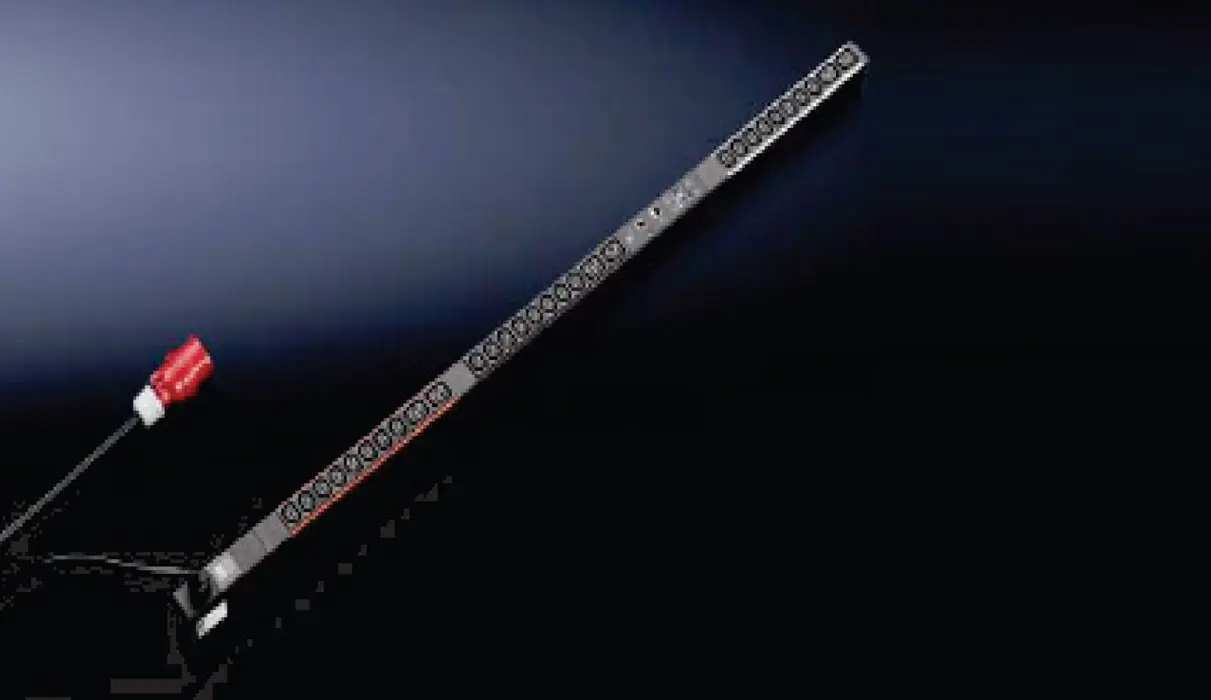
The Metered Power Distribution Unit (iPDU) is designed to provide accurate, real-time visibility into rack power usage at the inlet and phase level. It enables data center and IT teams to monitor electrical load, identify imbalance early, and maintain stable rack performance without adding unnecessary complexity.
The unit measures critical electrical parameters locally through an onboard display and remotely through standard network protocols. This makes it suitable for environments where uptime, predictability, and capacity planning are priorities, including enterprise data centers, co-location facilities, and distributed edge locations.
This metered inlet PDU focuses on reliability, straightforward deployment, and standards-based integration. For environments that require deeper control or outlet-level insight, socket-level metered and socket-level switched variants are available as part of the same PDU family.
Types of Power Distribution Units (PDUs)
Power Distribution Units (PDUs) are commonly categorized based on their monitoring and control capabilities. Understanding these types helps organizations select the right solution for their operational and visibility requirements.
There are four primary types of PDUs:
Basic PDUs
Basic PDUs provide reliable power distribution from a utility source, UPS, or generator to multiple devices within a rack. They do not include monitoring, metering, or remote access features and are typically used in environments where power visibility is not required.
Metered PDUs
Metered PDUs extend basic power distribution by adding local power monitoring through an onboard display. They provide real-time visibility into parameters such as current, voltage, and power factor. This helps operators balance loads effectively and detect potential overload conditions at the rack level.
Monitored PDUs
Monitored PDUs build on metered functionality by enabling remote power monitoring through a network interface. Administrators can view power usage data, receive alerts, and track trends from remote locations, reducing the need for on-site checks and improving operational responsiveness.
Switched PDUs
Switched PDUs include all the capabilities of monitored PDUs and add remote outlet-level control. Individual outlets can be turned ON or OFF remotely, allowing power cycling of connected equipment, scheduled power control, and faster recovery from unresponsive devices.
In addition to these core categories, some PDUs offer advanced capabilities:
- Automatic Transfer Switch (ATS) PDUs: Provide power redundancy for single-corded equipment by automatically switching to a secondary power source during a primary power failure.
- Hot-Swap PDUs: Enable maintenance or replacement of compatible UPS systems without interrupting power to connected equipment.
- Three-Phase PDUs: Designed for high-density environments such as data centers, supporting higher power loads and improved efficiency for demanding IT applications.
This Metered Inlet iPDU fits within the Metered PDU category, focusing on accurate inlet and phase-level visibility while maintaining deployment simplicity and operational reliability.
Key Benefits
- Real-time inlet and phase-level power monitoring
- Early detection of abnormal load conditions
- Improved capacity planning and load balancing
- Reduced need for on-site intervention through remote visibility
- Standards-based integration with existing monitoring systems
- Suitable for Zero-U and space-constrained rack deployments
Ideal Use Cases
- Data centers requiring phase-level power insight
- Co-location facilities managing shared infrastructure
- Edge sites with limited on-site staffing
- High-density racks where load balance is critical
- Enterprise environments focused on energy efficiency and scalability
Features
Monitoring and Metering
The iPDU measures and reports essential electrical parameters to support informed operational decisions.
Measured parameters include:
- Voltage (V)
- Current (A)
- Frequency (Hz)
- Active power (kW)
- Active energy (kWh)
- Apparent power (kVA)
- Apparent energy (kVAh)
- Power factor (cos φ)
Measurement is available per inlet and per phase, depending on the model configuration.


Electrical and Load Management
The PDU is engineered to support stable power distribution in demanding rack environments.
Key electrical characteristics:
- Rated current options: 16 A or 32 A
- Single-phase or three-phase configurations, model dependent
- Input power rating up to 7.4 kVA (model dependent)
- Designed for continuous operation in high-density racks
Connectivity and Integration
The unit integrates with standard IT and data center monitoring environments using widely adopted protocols.
Supported interfaces and protocols include:
- Ethernet (RJ45)
- SNMP v1, v2c, v3
- Web interface (HTTP, HTTPS)
- FTP and SFTP for updates and file transfer
- TCP/IP (IPv4 and IPv6)
- Email notifications via SMTP
- MIB support for third-party software integration
No proprietary software is required for monitoring or basic operation.


Safety and Protection
Built-in protection mechanisms help safeguard connected equipment and maintain operational stability.
Protection features include:
- Internal hydraulic-magnetic circuit breakers (16 A, model dependent)
- Overload protection
- Protection category IP20
Alert thresholds can be configured to notify operators when defined electrical limits are exceeded.
Build Quality and Installation
The iPDU is designed for long-term use in professional rack environments.
Construction and installation features:
- Slim vertical form factor
- Suitable for Zero-U mounting
- Lightweight aluminum construction
- Toolless mounting support (model dependent)
- Designed for installation in standard data center racks

PDU Dimensional Overview
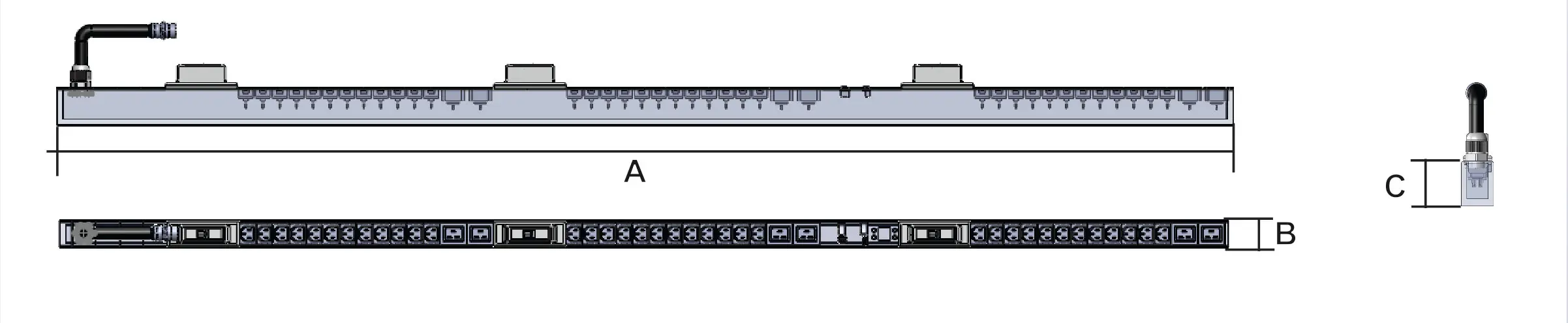
This diagram illustrates the physical dimensions of the Power Distribution Unit (PDU) to support accurate planning, rack compatibility checks, and installation readiness.
Dimension A – Overall Length
Represents the total horizontal length of the PDU body from end to end. This measurement is critical for confirming compatibility with rack depth and available mounting space.
Dimension B – Usable Mounting / Outlet Section
Indicates the effective length that contains the outlet banks and functional components. This helps assess outlet spacing, cable routing clearance, and alignment within the rack.
Dimension C – Connector / Inlet Projection
Shows the protruding depth of the power inlet or connector from the main PDU body. This is important for rear clearance planning, especially in high-density racks where space behind the PDU is limited.
Available Variants
Metered Inlet PDU
- Inlet and phase-level power monitoring
- Local display and remote network access
- Focused on visibility, reliability, and simplicity
Socket-Level Metered PDU
- All inlet monitoring features
- Additional per-outlet power measurement
- Supports detailed load analysis and energy tracking
Socket-Level Switched PDU
- Includes socket-level metering
- Adds remote ON and OFF control per outlet
- Enables remote rebooting and power sequencing
Frequently Asked Questions
Yes, depending on the model selected.
Temperature, humidity, or movement sensors can be added as needed.
No. It integrates with existing systems without requiring proprietary software.
No. Installation is the same for both models. The operational differences appear only after the units are commissioned.
Yes. Because switched PDUs allow outlet-level control, administrators can enable role-based access so only authorized users can manage switching actions.
Operators can define thresholds for various electrical parameters, and the PDU will trigger notifications when values exceed the predefined limits.
Yes. Both variants support common rack formats, including Zero-U and horizontal mounting, so they fit easily into most data center environments.
Far far away, behind the word mountains, far from the countries Vokalia and Consonantia, there live the blind texts. Separated they live in Bookmarksgrove right at the coast
Yes. Its slim profile and lightweight design make it suitable for Zero-U or other space-restricted rack positions.
The unit is designed for low-maintenance operation. Regular checks typically involve reviewing logs, monitoring thresholds, and ensuring proper airflow around the rack.