

Choosing the proper PCB assembly method can be confusing. Should you go with Surface Mount Technology (SMT) or stick to Through-Hole Technology (THT), especially if you’re not sure which one best fits your project? The wrong choice might affect durability, cost, or your device’s performance.
Don’t worry; we’re here to make it simple. We’ll break down the key differences between SMT and Through-Hole Technology (THT), compare their pros and cons, and help you decide which is better suited for your application, whether you’re building a compact consumer device or a rugged industrial machine.
Table of Content
What is the Difference Between Through-Hole and Surface Mount Technology?
| Feature | Surface Mount Technology (SMT) | Through-Hole Technology (THT) |
| Component Size | Smaller, allowing for higher density | Larger, limiting component density |
| Assembly Process | Automated, faster, and cost-effective | Manual or semi-automated, slower, and more labour-intensive |
| Mechanical Strength | Less robust, suitable for non-mechanical stress components | Stronger, ideal for components under mechanical stress |
| Repair and Prototyping | More challenging due to the small component size | Easier, components are accessible and easier to handle |
| Application Suitability | Ideal for compact, high-volume consumer electronics | Preferred for high-reliability applications like aerospace |
| Cost Efficiency | More cost-effective in mass production | More expensive due to drilling and manual assembly |
| Best For | Consumer electronics, laptops, smartphones, wearables | Power components, connectors, aerospace, and automotive |
What is Surface Mount Technology (SMT)?
Surface-mount Technology (SMT) is a method used in electronics manufacturing in which components are placed directly onto the surface of a printed circuit board (PCB) instead of inserted through holes. This technique uses solder paste and reflow soldering to secure parts like resistors, capacitors, and ICs. SMT allows for compact designs, faster production, and better automation, making it ideal for modern devices like smartphones, laptops, and wearables.
Advantages:
- PCB design fits more components onto both layers.
- Assembly robots create products fast at reduced manufacturing costs.
- Using fewer drills and materials decreases production expenses.
- Smaller wires create less expansive signal paths and block electronic signals.
- It helps create small smartphones, wearable technology, and Internet of Things equipment for the industry.
Disadvantages:
- Lower mechanical Strength – Not ideal for stress-bearing components.
- The inspection methods needed advanced technology, as manual checks were hard.
- This technology does not work well in demanding power setups because it can only handle limited heat removal.
- Small components become challenging to work with during proactive testing.
- Small components get harmed rapidly when exposed to humidity and electrical charge.
Applications:
| Application Category | Examples | Why SMT is Used |
| Consumer Electronics | Smartphones, laptops, tablets, and smartwatches | Miniaturisation, high circuit density, and fast production are essential for these compact devices. |
| Medical Devices | Portable heart monitors, hearing aids, and infusion pumps. | High reliability and space-saving design are crucial in medical-grade electronics. |
| Aerospace and Defence Electronics | GPS modules, avionics, and radar systems. | Critical for weight-saving and robust performance in extreme environments. |
What is Through-Hole Technology (THT)?
Through-hole technology (THT) is a method of mounting electronic components by inserting their leads into drilled holes on a printed circuit board (PCB). This process creates strong mechanical bonds, making THT ideal for high-power or heavy components in durable applications like automotive and aerospace electronics.
Advantages
- These bonds stand up well against physical pressures and vibrations.
- Proving tests become simpler since components attach and detach without issues.
- High-power pieces benefit from THT because it distributes heat and electrical currents better.
- Greater durability – Used in mission-critical industries like aerospace and defence.
- Assembling THT parts brings more tolerance than SMT parts because they align better in place.
Disadvantages
- Faster assembly takes longer to complete because it needs manual or semi-automated soldering.
- The production activity uses many workers
- PCB needs to drill holes.
- The number of parts on a PCB board needs more space and prevents shrinking the board size.
- The parts take up too much space to produce small devices efficiently.
- SMT shows better automation potential because it enables more efficient large-scale processing.
Applications:
| Application Category | Examples | Why HMT is Used |
| Aerospace & Defense | Missile systems, radar modules, and communication systems | High reliability and ability to withstand extreme conditions |
| Automotive Electronics | Engine control units (ECUs), ignition modules | Vibration resistance and mechanical strength |
| Industrial Equipment | Power supplies, motor controllers, heavy-duty relays | Strong mechanical bonds for durability and reliability in harsh industrial settings |
Mixed/Hybrid Assembly: Combining SMT and THT for Better PCBs
Mixed assembly, also known as hybrid assembly, combines Surface Mount Technology (SMT) and Through-Hole Technology (THT) on the same Printed Circuit Board (PCB). This method is used when some components require the durability of THT, while others are better suited for the compact design of SMT. By using both, manufacturers can maximize space, boost performance, and enhance design flexibility, making it ideal for complex electronics.
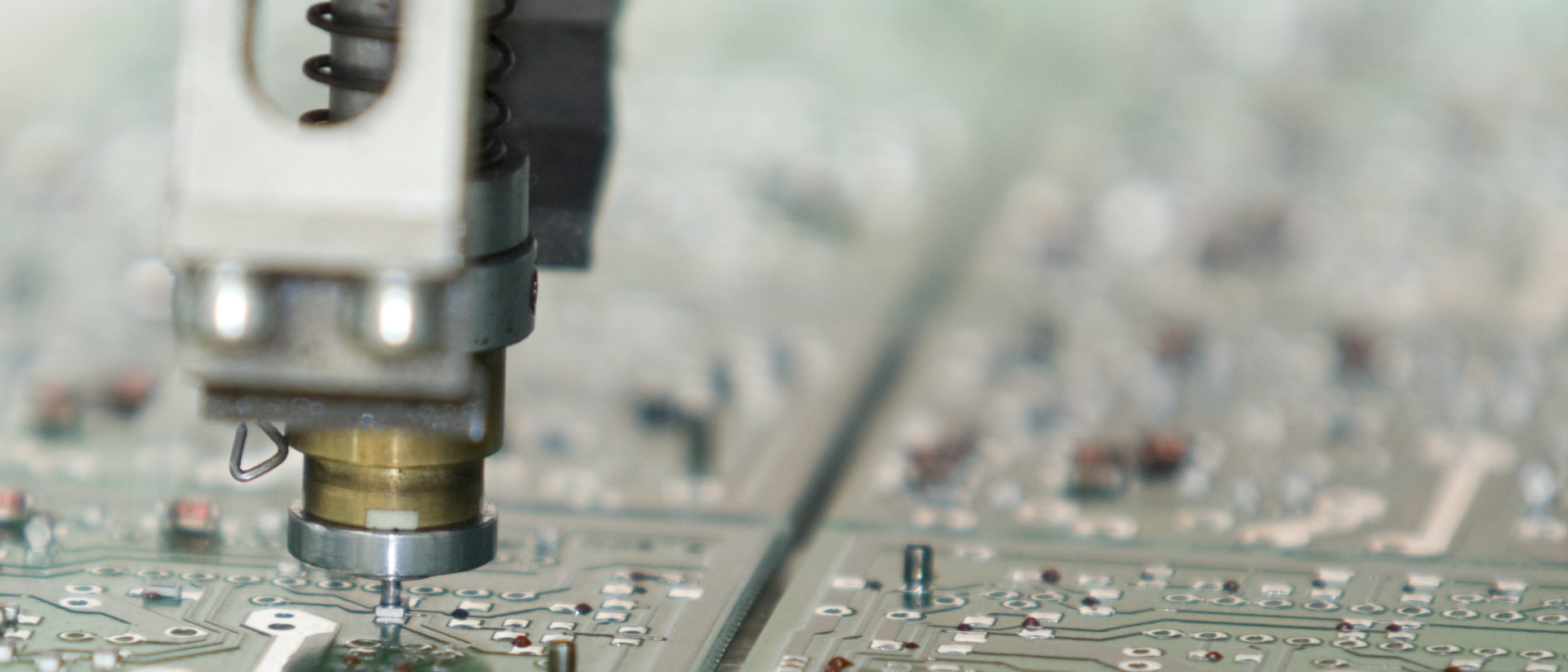
Why Mixed Assembly?
- Optimize Space: Maximize PCB real estate by using SMT for smaller components and THT for larger, more robust ones.
- Improve Performance: THT is perfect for components that need extra strength or higher currents, boosting overall performance.
- Design Flexibility: Mix both technologies to create a more flexible, efficient design for various applications.
In short, mixed assembly gives you the best of both worlds, improving performance and design flexibility. The Study by Global Market Insights shows SMT will generate more than $10 billion by 2032 as customers want smaller electronic devices connected to the Internet of Things.
Emerging Trends in PCB Assembly
Miniaturization
More powerful electronic devices drive the need for smaller devices, which has become a dominant market trend. Through precise component placement, SMT supports manufacturers in making powerful, compact products.
3D Printing for PCBs
New 3D printing techniques deliver better PCB production for fast prototyping and making intricate patterns that standard manufacturing cannot create.
Flexible PCBs Using SMT
The production of flexible printed circuit boards enables medical device and wearable technology improvements. SMT helps put components on flexible pads to make electronic items that can be bent and folded.
Environmental Impact of SMT and THT
Manufacturers need to evaluate the environmental effects of SMT and THT production as electronic sustainability rises in importance. Surface Mount Technology produces fewer costs in raw materials and power because it handles small components with automated systems.
Through-hole technology uses higher amounts of solder and energy due to manual pickup and the use of large components. When used in products, THT items usually survive better than their counterparts, which helps them have extended operational lives. Businesses use environmentally friendly production techniques to create profitable products that conserve resources.
Which Is Better?
The dispute between SMT and Through Hole technologies has no ultimate solution. Your choice relies on various project variables like the type of job you build and how much you plan to spend.
- Use Surface Mount Technology for builds that need compact production at fast speeds with large numbers.
- Through-hole technology serves best when dependability, strength, and stability matter.
- You should integrate both technologies into your design for maximum outcome.
The right production partner and approach make all the difference, no matter what your electronic development focus is. MicroLOGIX experts help you combine speed, accuracy, and reliability in your electronic project design.
MicroLOGIX: Your Partner in PCB Assembly Design and Manufacturing Services
MicroLOGIX delivers total PCB assembly services that address many different industry requirements. Our facility houses modern SMT assembly machines and automation tools, including reflow ovens and AOI systems, to deliver precise and efficient production results.
Our services include:
- Design support and prototyping
- Our company handles PCB parts procurement and complete printed circuit board production
- Functional testing and quality assurance
- Expertise in both SMT and THT assembly methods
MicroLOGIX is dedicated to providing both dependable and affordable tailored electronic solutions, with expertise in designing unique PCB assembly services for each client based on their operating needs.
FAQs
Q1: What is the full form of THT?
THT stands for Through-Hole Technology. It is a method of attaching electronic components to a PCB by inserting the component’s leads through holes and soldering them on the opposite side.
Q2: What are the main differences between SMT and THT?
SMT technology installs electronic parts on the top surface of printed circuit boards to achieve closer element packing and automatic production. The THT assembly method connects components leading to PCB holes through manual insertion, yet demands more space and labor.
Q3: Which technology is better for high-reliability applications?
Companies use THT technology to build aerospace and military equipment because it provides strong bonds and handles stress very well.
Q4: Can SMT and THT be used together on the same PCB?
Manufacturers use this combined strategy to take advantage of SMT and THT technology benefits in specific areas of the circuit board.
Q5: What are THT components?
THT components are larger electronic parts like resistors, capacitors, diodes, and ICs designed for Through-Hole Technology (THT) assembly. These components are easier to handle and solder manually, making them ideal for high-reliability applications like aerospace and military electronics.